How Long Are Business Checks Good For?
At Checkomatic, we take pride in our ability to debunk business check myths and provide valuable answers to frequently asked questions. So, how long are business checks good for? Do they expire?
When you purchase a business check with your information printed, the check is good to use as long as your information is accurate. Once your personal information is changed and the information on the printed business check is no longer accurate, the check is considered expired. However, a business check that already has a date printed on it, is only valid for six months , even if the check says void after 90 days, the bank might accept it for up to six months. Keep in mind, these expiration restrictions apply to all types of business checks; despite where they are purchased.
As a business owner, we recommend you shred an expired blank business check to ensure fraud prevention as a bank can still decide to deposit it. To avoid being stuck with expired business checks, Checkomatic recommends setting up a mobile deposit through your bank's smartphone application or purchasing a deposit machine. If you don't have to physically make a trip to the bank to deposit your business check, you are more likely to deposit your business checks on time.
As always, please contact our customer service at 1-800-555-6374 or sales@checkomatic.com with any questions.
Visit Checkomatic.com to shop Business Checks, Computer Checks, or Manual Checks.
Blank Check Stock Validity vs Dated Checks
As the original content correctly identifies, there are two different situations to understand when asking how long business checks are good for: blank check stock (with no date written on it yet) and a check that has already been dated and issued to a payee.
Blank Check Stock , No Time Limit Based on Age
A blank business check sitting in your check supply with your business name, address, routing number, and account number pre-printed on it, but no date, payee, or amount written yet, is not subject to the six-month stale date rule. There is no date to count from. The check is valid to use as long as the pre-printed information on it accurately reflects your current banking details and business information.
The expiry condition for blank check stock is a change in information, not the passage of time. If your business changes its address, if your business name changes, if you change banks, or if your account number changes, the blank check stock with the old information is effectively expired because the information is no longer accurate. This is the expiry scenario the original content correctly describes.
| Check Type | Valid Until | Expired When |
|---|---|---|
| Blank check stock (no date written) | Indefinitely , no time limit based on age | Account information or business details change |
| Dated check (date written, issued to payee) | Six months from the written date | Six months pass without the payee depositing it |
| Check marked "void after 90 days" | Banks may accept for up to six months , policy varies | Six months from issue date in most cases |
Dated Checks , The Six-Month Rule Applies
Once you write a date on a check and issue it to a payee, the six-month stale date clock starts. As the original content correctly identifies, a check with a date printed on it is only valid for six months. This applies to all check types: business checks, payroll checks, personal checks, and any other check drawn on a personal or business bank account.
The 6-Month Stale Date Rule Explained
The six-month stale date rule comes from UCC Article 3, which governs negotiable instruments in the United States. Under UCC 3-304(a)(2), a check is considered "overdue" if it has been outstanding for more than 90 days, and under UCC 3-118, banks are generally not obligated to honor checks more than six months old.
The practical effect of this rule is that most US banks will decline to process a check that was issued more than six months ago. A payee who receives a check and waits more than six months to deposit it may find that their bank returns the check unpaid. At that point, the payee would need to contact the payer to request a replacement check.
What "Stale-Dated" Means in Practice
A stale-dated check is one where the written date on the check is more than six months in the past. Banks identify stale checks during processing and may flag them for review or return them unpaid, depending on their internal procedures. The original content correctly identifies that the six-month validity rule applies to all types of business checks regardless of where they are purchased.
For the complete guide to how check clearing and bank processing timelines work, see how long do business checks take to clear.
What "Void After 90 Days" Actually Means
As the original content correctly identifies, even if a check says "void after 90 days," the bank might accept it for up to six months. This is one of the most common misunderstandings about business check validity, and the original Checkomatic guide addresses it directly.
The "void after 90 days" notation printed on some business checks is a request from the account holder to the payee: please deposit this check within 90 days of issuance. It is not a binding instruction to the bank. The bank's obligation to honor or decline a check is governed by UCC Article 3, not by notations printed on the check face by the account holder.
Why Businesses Use "Void After 90 Days" Notation
Businesses print this notation for several legitimate reasons. It encourages payees to deposit checks promptly rather than holding them for months, which helps businesses maintain cleaner accounts and reduces the risk of confusion when a check appears on a bank statement long after the payment was expected to clear. It also signals to the payee that the business may not honor a replacement if the check is presented significantly late. However, none of this obligates the bank to decline the check before six months have passed.
When a Bank Can Refuse a Stale-Dated Check
Under UCC Article 3, a bank is generally not obligated to honor a check that was issued more than six months ago. However, the same law also does not prohibit a bank from honoring a stale check if it chooses to. Different banks have different internal policies for how they handle stale-dated checks during processing.
Standard Practice at Most Banks
Most US banks run checks through automated processing systems that flag items where the check date is more than six months old. When a check is flagged as stale, the bank's processing system may automatically return it unpaid, or it may route it to a manual review queue where a staff member decides whether to pay or return it. The outcome depends on the specific bank's policy and the circumstances of the account.
What to Do if You Need to Deposit a Stale Check
If you receive a business check that is older than six months, contact the payer first and ask for a replacement check. This is the simplest path. If the payer confirms the check is still valid and asks you to deposit it, contact your own bank and explain the situation before depositing. Some banks will process a stale check if the account holder (the payer) confirms in writing that the check is still authorized for payment. Do not simply try to deposit a stale check without checking with your bank first.
How to Safely Dispose of Expired Business Checks
Every Checkomatic business check contains pre-printed MICR-encoded banking details , reason enough to shred expired stock rather than simply discarding it.
As the original content correctly recommends, shred expired blank business checks. This is important because an expired blank check still contains your routing number and account number in the MICR line at the bottom, even if the business name or address on the check no longer matches your current details.
Why Shredding Is Essential
As the original content correctly notes, a bank can still decide to deposit an expired blank check. A check with outdated information may be returned by a bank, but the attempt itself creates a problem. More importantly, someone who obtains an expired blank check with your routing and account number can use that information to create fraudulent checks drawn on your account, even if the original check's information is outdated. The account and routing numbers are what matter for fraud purposes, not the printed business name or address.
Cross-cut shredding destroys both the printed face of the check and the MICR line at the bottom, making the banking details unrecoverable. Simple tearing leaves the check in pieces that can be reconstructed. For the complete guide to check fraud protection, see what is check washing and how to protect your business and are business checks safe: security features that actually matter.
What Counts as an Expired Blank Check
- Blank check stock with a business name or address that no longer matches your current registered business information
- Blank check stock with a routing or account number from a bank account you have closed
- Blank check stock from a previous business entity that has been dissolved or restructured
- Blank check stock where your bank has changed your account number for any reason
In all of these cases, the check cannot be used for legitimate payments. Shred it promptly and place a new order with your current information. For business check ordering, see business checks.
How to Avoid Expired Check Supply Problems
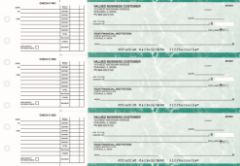
Ordering the right quantity of Checkomatic business checks for your usage rate helps you avoid holding outdated check stock.
Mobile Deposit , As Recommended in the Original Blog
As the original content correctly recommends, setting up mobile deposit through your bank's smartphone application helps ensure you deposit received business checks promptly. Checks that sit in a desk drawer for weeks or months are at risk of going stale before being deposited. Mobile deposit eliminates the friction of a bank trip, making it more likely that received checks are deposited within a reasonable timeframe.
Order Quantities That Match Your Usage Rate
Blank check stock expiry from information changes is the primary risk for businesses holding large check supplies. The best way to avoid this is to order quantities that align with your monthly check writing volume. If your business address, banking details, or business name changes, you want to minimize the amount of outdated stock you have to shred.
A simple calculation: if you write 20 checks per month, a 500-check order represents about 25 months of supply. That is a reasonable buffer. A 1,000-check order at the same volume is over four years of supply, which significantly increases the risk that something changes before you use it all. For ordering guidance and bulk discount options, see business checks.
Track Your Check Supply With a Check Register
A check register lets you track how many checks you write each month and estimate when your supply will run out. This helps you reorder before you run out, without ordering so far in advance that you accumulate more supply than your usage rate can absorb before your information changes. For the complete check register guide, see check register: how to set up and use a checkbook ledger. For the complete checkbook management guide, see checkbook management: how to balance and reconcile.
What Customers Say About Checkomatic
All reviews below are published on checkomatic.com and reproduced verbatim. Source: checkomatic.com/quickbooks-starter-pack-product, 4.5 stars from 166 verified reviews.
"Been with them for 15 years. Always reliable, always good quality, good service. What more can you ask for?"
ATV Inc. | ★★★★★ 5/5 | April 5, 2024 | Source: checkomatic.com/quickbooks-starter-pack-product
"First time ordering and I am super impressed with the quality of the checks. No issues with delivery. I will be ordering again!"
TClinton | ★★★★★ 5/5 | April 9, 2025 | Source: checkomatic.com/quickbooks-starter-pack-product
"We use CheckoMatic for all of our check needs! They have great prices and we receive our products in a timely manner!"
CG's Tax Service | ★★★★★ 5/5 | September 18, 2024 | Source: checkomatic.com/quickbooks-starter-pack-product
"I got 500 checks for less than half of what the bank wanted for 200!"
VVA Voucher Checks (Vietnam Veterans of America) | ★★★★★ 5/5 | July 6, 2024 | Source: checkomatic.com/quickbooks-starter-pack-product
"ASJ Wilson Construction has been a client of checkomatic for some years now and they've never disappointed this company. Thank you checkomatic for all that you do."
ASJ Wilson Construction | ★★★★★ 5/5 | June 6, 2024 | Source: checkomatic.com/quickbooks-starter-pack-product
"Affordable and efficient. My go-to business check printer."
Doe | ★★★★★ 5/5 | January 24, 2025 | Source: checkomatic.com/quickbooks-starter-pack-product
Why Choose Checkomatic for Business Checks
Order Quantities That Match Your Business
As the original content correctly identifies, managing how long business checks are good for is partly a function of ordering the right quantity for your usage rate. Checkomatic offers business checks from small starting quantities through large bulk orders with volume discounts. This flexibility lets you match your order size to your actual usage rate and minimize the risk of holding check stock past its useful life. Browse all formats at business checks, computer checks, and manual checks.
Security Features That Matter When Disposing of Old Stock
As the original content correctly recommends, shredding expired check stock is essential for fraud prevention. Checkomatic's business checks include ANSI E13-B certified MICR encoding that bank fraud systems use to process and verify checks. This is also why expired stock must be shredded: the MICR line contains your real banking details regardless of whether the business name or address on the check is still current. For the complete security feature guide, see are business checks safe: security features that actually matter.