-
 Contact Us
-
 Re order
-
 Log in
-
 Cart 0
You have no items in your shopping cart.
How to Mail a Check Safely, Step by Step
A paper check still has to travel. Once you write it, the hard part is getting it to the payee without it going astray or being altered. It is easy to drop it in the nearest box and hope.
This guide gives you a routine you can repeat. It covers filling out the check, addressing the envelope, choosing where to mail it, logging it, and what to do if it never arrives.
Quick Summary
To mail a check, fill it out in black ink, seal it in a sturdy envelope, address it clearly and hand it over at a post office or drop it before the last pickup. Then record it and ask the payee to confirm. Extra USPS services add proof but are not required.
Key points
- Fill it out fully. The FBI advises indelible black ink and no blank space on payee or amount lines.
- Use an envelope you can seal well. The FBI also suggests security envelopes for checks sent by mail.
- A return address is a good habit, not a rule. USPS rules do not require one on a standard First-Class letter.
- Pick the drop point with care. Federal agencies point to the post office, and its indoor slot, over a home mailbox.
- Plain First-Class has no tracking. Certified Mail adds proof of mailing and delivery.
- Log it and tell the payee. A short record makes a missing check easy to chase.
| Step | What to do | Why it helps |
|---|---|---|
| Fill out | Black ink, no gaps, signed | Leaves little room to alter |
| Envelope | Sturdy, sealed, clearly addressed | Protects the contents |
| Post office or before last pickup | Limits time in a box | |
| Record | Log number, date and method | Matches your register |
| Confirm | Ask the payee to tell you it arrived | Spots a problem early |
Table 1. The mailing routine at a glance. Sources: FBI alert of January 2025 and USPS guidance. See our check register guide.
Paying vendors by mail every week? Ask our team to match envelopes and check layouts to your payables run.
In this guide
- How do you mail a check, step by step?
- What envelope should you use to mail a check?
- What goes on the envelope, and do you need a return address?
- Where should you drop it?
- Is Certified Mail worth it for a check?
- What should you record and tell the payee?
- What if a mailed check never arrives?
- When is mailing a check the wrong choice?
- Frequently Asked Questions
How Do You Mail a Check, Step by Step?
You fill out the check, seal it in an envelope, address it, take it to a safe drop point and keep a record. Follow this order and the risks shrink at each stage.
- Write the check completely. Use black ink, fill every line and sign it.
- Add what the payee needs to match it. An invoice number on the memo line or a short note. Keep your Social Security and phone numbers off the check.
- Choose a sturdy envelope. A security envelope is the better choice.
- Seal it and check the flap. Press along the whole edge before you move on.
- Address it clearly. Add your own return address.
- Pick the mailing method. A plain letter or an added USPS service.
- Mail it at a safe point. Use the letter slots inside the post office.
- Record it and tell the payee. Then watch your account for it to clear.
How should the check itself be filled out first?
Fill it out so nobody can add to it. The FBI's January 2025 alert on mail theft and check fraud advises indelible black ink, no blank space on the payee or amount lines, and no Social Security number or phone number on the check. Each line is explained in filling out a check, and writing a business check covers company accounts.
Does paying a tax bill by check change anything?
It can. Follow the payee and memo instructions on your tax notice, and see our IRS payment check guide.
Which Envelope Works Best for Mailing a Check?
Use a sturdy envelope you can seal firmly. The FBI's alert recommends security envelopes for checks, which are made so the contents are harder to see. We found no federal rule that requires one particular envelope type, so this is guidance, not law.
Is a window envelope acceptable here?
Often yes, if the window shows only the address and the check itself stays hidden. The FBI's alert suggests envelopes that conceal the contents of your mail, so look through the window before you seal it. A check envelope with a window saves writing the address twice for vendors you pay often.
Peel-and-seal or gum flap?
Both can work. Press the flap shut along its full length and check the corners.
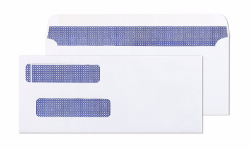
Our range of envelopes includes window and plain styles in several flap types.
What Goes on the Envelope, and Do You Need a Return Address?
Write the recipient's name, then the street line, then the city, state and ZIP code, all on the same side as the postage. A return address is not required on a standard First-Class letter, but it is worth adding. That is the order and the rule in the USPS Domestic Mail Manual, section 602.
When does a return address become a requirement?
The same USPS manual section says a return address is required for Certified Mail sent with a return receipt. For a plain letter it is optional. We suggest adding one so the envelope can come back if it cannot be delivered.
Where Should You Drop It: Post Office, Blue Box or Mailbox?
The FBI advises using the letter slots inside your local post office. The OCC's check fraud page, posted December 2024, advises using a post office letter slot rather than a home mailbox. The Postal Inspection Service adds that outgoing mail should not sit in your mailbox overnight.
Use this short checklist on mailing day. It points to our full guides instead of repeating them.
- Go inside if you can. The FBI advises the letter slots inside the post office.
- Using a blue box? Time it. Mail it close to pickup and before the final collection.
- Skip the home mailbox. Outgoing mail should not sit there overnight.
- Traveling soon? Ask USPS to hold your incoming mail.
- Business account? Ask your bank about positive pay, which the FBI also suggests.
- Read the deeper guides. See how check washing works and check fraud prevention.
Why do federal agencies keep warning about mailed checks?
Because mail theft feeds check fraud. FinCEN's alert of February 2023 said criminals target USPS blue collection boxes, and its September 2024 analysis counted 15,417 reports from 841 institutions in the six months after the alert, covering over $688 million in suspicious activity. See check fraud in 2026.
Does Informed Delivery help with a check you send?
USPS describes Informed Delivery as a preview of incoming letter-sized mail, and its page does not describe it for letters you send. Use a tracked service or ask the payee.
Does Certified Mail Pay Off for a Check?
It is worth it when the payment is large, urgent or must be provable. Certified Mail gives proof of mailing and delivery and can go with First-Class Mail. A plain First-Class letter has no tracking unless you add a service, according to USPS.
| Method | What USPS says you get | Our view of the best fit |
|---|---|---|
| First-Class letter | Delivery stated as 1 to 5 days; tracking only with certain extra services | Routine, low-risk payments with a payee who confirms |
| Certified Mail | Proof of mailing and delivery, bought at a Post Office | Payments you may need to prove you sent |
| Certified Mail plus Return Receipt | A signature record of delivery | Disputed or deadline-driven payments |
| Registered Mail | Insurable, bought at a Post Office | High-value items, if the counter agrees it fits |
| Priority Mail | Some insurance and a barcode included | When you want a barcode and some included insurance |
Table 2. Mailing methods compared, per USPS pages. Ask the counter for current terms. See check clearing times.
When is a plain First-Class letter enough?
A plain letter plus a quick confirmation is often reasonable for small, regular payments to a known payee. We found no federal rule that requires tracking on a mailed check.
Does postal insurance cover a lost check?
We did not confirm that. USPS says First-Class insurance is a paid add-on, while Priority Mail includes some, but USPS sets the terms. Ask the counter before you rely on it, and see lost checks and replacements.
What Should You Record and Tell the Payee?
Record the check number, the date, the amount and how you mailed it, then message the payee the same day with the check number, amount, date and method. The FBI's alert tells senders to confirm with the payee that the check arrived. A written log makes that confirmation routine.
Keep the log beside your register. A typical register tracks number, date, payee, amount and a cleared mark, so add only the mailing columns.
| Log field | What to write | Matches in your register |
|---|---|---|
| Check number | The number printed on the check | Check number column |
| Date written | The date on the check | Date column |
| Payee | Exact name on the payee line | Description column |
| Amount | The figure in numerals | Payment column |
| Date and place mailed | Day and drop point used | Notes column |
| Method and tracking number | Letter, Certified Mail, or similar, with the number | Notes column |
| Payee confirmed | The date they told you it arrived | Notes column |
| Date cleared | The day it shows on your account | Cleared box |
Table 3. A sender's mailing log mapped to a standard check register. See checkbook management for keeping both together.
How do you know when it has been cashed?
Look at your account online; the FBI also advises using online or mobile banking to review your account activity. Deposit time and bank processing both affect when it shows, so check clearing times vary. Once it posts, our guide to a copy of a cancelled check explains how to request one.
What If a Mailed Check Never Arrives?
Check your account, ask the payee, then act. If the check has not cleared and has not arrived, stop payment and send a replacement. If it cleared but the payee never got it, call your bank straight away. There is no rule that defines a check as lost after a set number of days.
The routine below is a suggestion, not a rule. USPS states First-Class delivery as one to five days, so a week leaves time before you chase. See lost checks and replacements for the replacement process.
| When | What you see | Suggested action |
|---|---|---|
| Mailing day | Check logged, payee told | Note the method and any tracking number |
| About a week later | Payee has not confirmed | Ask the payee to look again and check your account |
| Still missing, not cleared | Not received, not posted | Stop payment on that number, then reissue |
| Not received, but it posted | Someone else may have cashed it | Call your bank at once and report it |
| You suspect theft | Mail or box tampering | Report to the Postal Inspection Service and police |
Table 4. A suggested follow-up routine for a mailed check. Sources: FBI, OCC and USPIS guidance. Our stop payment guide has the steps.
How long does a stop order stay active?
Under the model UCC 4-403, a stop payment order lasts six months, and an oral order lapses if no record confirms it within 14 days. States adopt their own versions, so ask your bank how its process works. The full walkthrough is in our guide to stopping payment on a check.
Who do you report a stolen check to?
The OCC says to notify your bank, then report to the FBI's Internet Crime Complaint Center, the FTC, the Postal Inspection Service and the police. The Postal Inspection Service takes reports online or by phone at 1-877-876-2455, and 911 is for a crime in progress. For next steps on your account, see check fraud prevention.
When Is Mailing a Check the Wrong Choice?
Mailing is a poor fit when the payment is large, urgent or must land by a hard deadline. The FBI's alert suggests considering electronic payment options.
- Bank transfer or ACH. Compare speed and control in our guide to check versus ACH payment.
- Guaranteed funds. A certified check or money order is another route; ask the payee what they accept.
Ready to mail with confidence
Envelopes that match. Window and plain check envelopes keep addresses tidy and flaps secure.
Checks built for business. Our business checks carry the layout your register expects.
A proof before you commit. Review each design first so every field is right.
Help from a person. Not sure what suits your mail volume? Ask us.
About the Author
Our in-house Checkomatic writers prepared this for senders of mailed payments, using the FBI's January 2025 alert on mail theft and check fraud, FinCEN's alert and later analysis, the OCC's check fraud resource, Postal Inspection Service guidance, USPS pages on First-Class Mail and extra services, the Domestic Mail Manual, and the model UCC 4-403.
General information only, not legal advice. USPS terms change and states adopt their own versions of the UCC, so confirm current services with the Post Office and stop payment rules with your bank or a lawyer.
Frequently Asked Questions
How long does a mailed check take to arrive?
Can you mail a check without a return address?
Is it safe to put a check in my home mailbox for pickup?
Do you have to track a check you mail?
Can you mail a check to deposit it at a bank?
Should you tell the payee a check is on its way?
Which pen should you use on a check?
Can Informed Delivery confirm that my outgoing check was delivered?
What should I do if my mailed check was stolen and cashed?
Are there safer ways to pay than mailing a check?
Accepted by the world’s leading banks