Blog

Jul 31, 2026

How to Print Checks in QuickBooks Online: Step-by-Step Guide

Learning how to print checks in QuickBooks Online requires four things to be in place before you click print. Missing any one of them causes the most common printing failures.

  • An active QuickBooks Online subscription. Check printing is available on all QBO plans: Simple Start, Essentials, Plus, and Advanced. No additional module is required.
  • QuickBooks-compatible MICR check stock. QuickBooks Online does not print on blank paper. The check stock must be pre-printed with your company name, address, ABA routing number, and account number in certified MICR magnetic toner. The paper must be 8.5 by 11 inches and formatted to match QBO's print template in your chosen style (Voucher, Standard, or Wallet).
  • A laser or inkjet printer. Both work. Laser printers produce sharper MICR output when printing variable payment details. Alignment accuracy is the most important factor regardless of printer type.
  • Adobe Acrobat Reader (free). QuickBooks Online generates a PDF when you print checks. You must open and print that PDF through Adobe Acrobat Reader specifically, with scale set to 100 percent (Actual Size). Printing through a browser PDF viewer or at any scale other than 100 percent causes misalignment.


Choosing the Right Check Stock to Print Checks in QuickBooks Online

The most common reason how to print checks in QuickBooks Online fails is not a software problem. It is a check stock mismatch. If the physical check stock you load into your printer does not match the format QuickBooks Online is configured to print, every check in the batch will be misaligned and unusable.

[IMAGE 2 | Source: checkomatic.com/computer-checks | Link: checkomatic.com/computer-checks | ALT: Computer checks on top voucher format loaded in printer tray for QuickBooks Online check printing showing 8.5 x 11 inch pre-printed MICR check stock]

QuickBooks Online supports three check formats. Before ordering check stock, confirm which format your QBO account is configured to use. To check: go to the gear icon, select Print Checks, then Print Setup, and read the check style displayed.

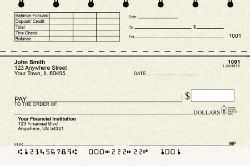
  • Voucher (check on top): One check per page with two detachable stubs below. The QuickBooks Online default. Best for payroll and accounts payable where remittance detail on the stub matters.
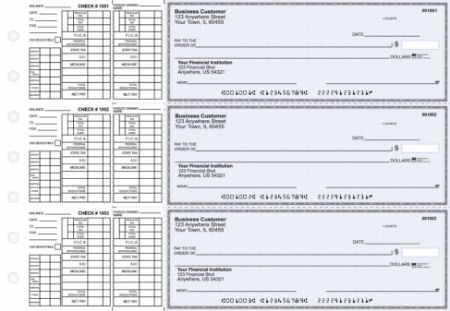
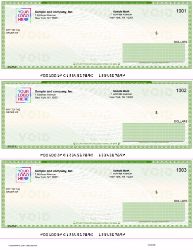
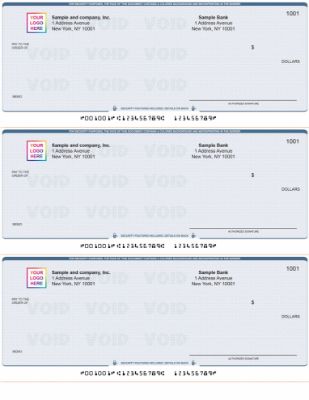
  • Standard (3-on-a-page): Standard checks , three checks per sheet with no stubs. Efficient for high-volume AP where all records are kept digitally in QuickBooks.
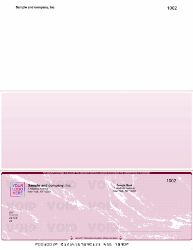
  • Wallet: Three smaller personal-size checks per sheet. Occasionally used for low-volume personal-style business payments.

Do not order check stock without first confirming your QBO format setting. Ordering Voucher stock when QuickBooks is set to Standard, or vice versa, produces a full batch of unusable checks. See our complete format comparison at QuickBooks-compatible checks guide.
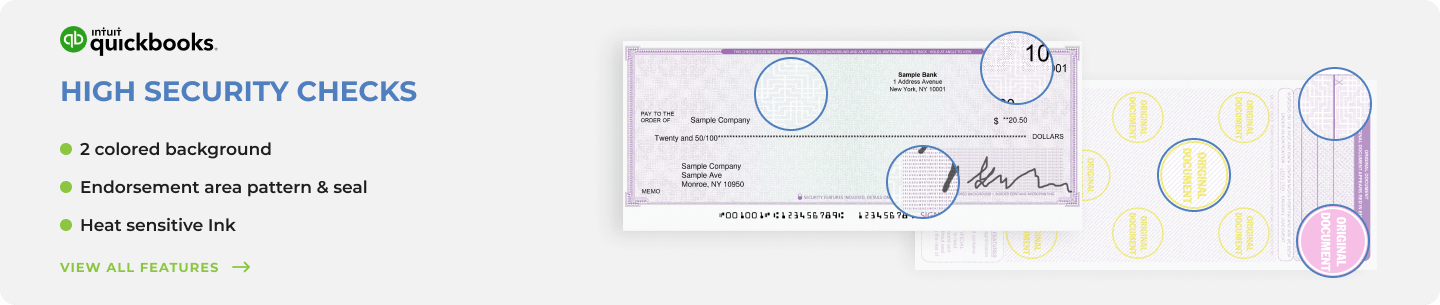
2 colored background, Endorsement area pattern and seal, Heat sensitive Ink


Step 1: How to Set Up and Align Your Printer for QuickBooks Online Check Printing

Printer alignment for checks is a one-time setup that QuickBooks Online remembers for future use. Complete this step before printing your first real check. If you switch printers or change check formats later, repeat this step.

  1. Go to + New in the top-left corner of your QuickBooks Online dashboard.
  2. Select Print Checks from the menu.
  3. Click Print Setup in the top-right of the Print Checks screen.
  4. Select your check style (Voucher or Standard). The check style in QuickBooks determines which format the software prints to. If you use Wallet checks, select Standard and load Wallet stock.
  5. Load one sheet of plain white paper into your printer.
  6. Click View Preview and Print Sample, then click Print.
  7. Take the printed sample and place it on top of a blank check from your check stock. Hold both up to a light source.
  8. Check whether the dollar amount, payee name, date, and MICR area on the sample line up with the corresponding areas on the check stock.
  9. If everything lines up: click Yes, I'm finished with setup. Alignment is complete.
  10. If anything is misaligned: click No, Continue Setup. Drag the blue grid on the screen to adjust the position of the print output. Move the grid up, down, left, or right until the sample matches the check positions. Print another sample and repeat.


Step 2: How to Record a Check in QuickBooks Online for Printing

Before you can print a check in QuickBooks Online, you must record it. Recording the check enters the transaction into your books and marks it for the print queue.

  1. Go to + New and select Check.
  2. In the Payee field, select the vendor, supplier, or employee from your list. If they are not in your list yet, click Add New to create the payee record.
  3. In the Bank Account field, select the checking account from which this payment will draw.
  4. Enter the payment Date. For checks you want to print later, use today's date or the intended payment date.
  5. Check the Print Later box. This is the critical step. Checking Print Later changes the Check No. field to "To Print" and adds this check to the print queue. If you do not check Print Later, the check will not appear in the print queue.
  6. In the Category field, select the expense account that best describes the payment (supplies, utilities, contractor fees, etc.).
  7. Enter the Amount in the dollar field.
  8. Add a Memo if you want reference notes to appear on the check stub.
  9. Click Save and Close to record the check and add it to the print queue.

Repeat this process for every check you want to print. QuickBooks Online queues all of them together for batch printing.


The print queue in QuickBooks Online holds all checks marked Print Later. This is the print queue in QuickBooks where all pending checks wait before printing. You can add as many checks as needed and print them all in one batch.

  1. Go to + New and select Print Checks.
  2. From the Account dropdown at the top, select the bank account you are printing from. Only checks from that account appear in the queue.
  3. Review the list of checks waiting to print. Each shows the payee name, date, and amount.
  4. To remove a check from the current print batch without deleting it, uncheck the box next to it. Unchecked checks remain in the queue for the next print session.
  5. To remove a check from the queue permanently, open the check itself, uncheck Print Later, enter a manual check number, and save. This records it as a handwritten check rather than a printed one.


Step 4: Enter the Starting Check Number for QuickBooks Online Printing

The starting check number is one of the most important fields in the QBO printing process. Getting it wrong causes your check number sequence and physical check register to fall out of order, creating reconciliation problems later.

  1. Look at the first physical check loaded in your printer tray. Read the check number printed on that check (top right corner).
  2. Enter that number in the Starting Check No. field in QuickBooks Online.
  3. QuickBooks Online numbers the remaining checks sequentially from there. If you are printing 5 checks starting at check number 1045, QBO will print checks numbered 1045, 1046, 1047, 1048, and 1049 automatically.
Common mistake: Entering a starting check number that does not match the physical check in the printer. This assigns QuickBooks record numbers that do not match the printed check numbers, making bank reconciliation difficult. Always verify the number on the first physical check in the tray before entering the starting number.

For help understanding check numbering and ABA routing numbers on your check stock, see our ABA routing numbers guide.


[IMAGE 3 | Source: checkomatic.com/quickbooks-compatible-checks | Link: checkomatic.com/quickbooks-compatible-checks | ALT: QuickBooks compatible check formats from Checkomatic showing voucher check on top, standard 3-on-page, and wallet formats for QuickBooks Online check printing]
  1. Load your QuickBooks-compatible check stock into the printer. Face-up or face-down depends on your specific printer model , check your printer manual for the correct paper orientation if you are unsure.
  2. In the QuickBooks Online Print Checks screen, check the box next to each check you want to print in this batch.
  3. Click Preview and Print. The preview and print QuickBooks step shows exactly how each check will look before committing to real check stock.
  4. QuickBooks Online generates a PDF file. Your browser will attempt to open or download it.
  5. Open the PDF in Adobe Acrobat Reader. Adobe Reader check printing at 100 percent scale is the required method. Do not print from the browser's built-in PDF viewer.
  6. In Adobe Acrobat Reader's print dialog, set the print scale to 100% or Actual Size. This is the most critical setting. Do not use Fit to Page.
  7. Select your printer and click Print.

After the checks print, do not remove them from the output tray until you have reviewed every check against the QuickBooks Online preview to confirm correct alignment and information.


Step 6: Confirm Printing Results in QuickBooks Online

After printing, QuickBooks Online displays a confirmation screen. This step is important because it determines which checks are removed from the print queue and which are returned for reprinting.

  1. Review each printed check against the preview shown in QuickBooks Online.
  2. If all checks printed correctly: click Yes, they all printed correctly, then click Done. QuickBooks Online removes these checks from the print queue and marks them as printed in your register.
  3. If one or more checks did not print correctly: click Some checks need reprinting. Enter the check number of the first check that needs to be reprinted. QuickBooks Online returns those specific checks to the print queue. Checks that printed correctly are removed from the queue.
  4. If none of the checks printed: click Keep all checks in the print list. All checks return to the queue for another attempt after you fix the underlying issue.
 

How to Print Checks in Batches in QuickBooks Online

Batch printing is one of the biggest time-saving advantages when you know how to print checks in QuickBooks Online correctly. Rather than printing each check individually, you can record as many checks as needed throughout the day or week, then print all of them in a single print run.


Best Practices for Batch Check Printing in QuickBooks Online

  • Group checks by bank account. QuickBooks Online filters the print queue by bank account. If your business uses multiple checking accounts, print all checks from one account before switching to the next.
  • Sort before printing. Review the print queue before printing and confirm the check sequence makes sense. Printing from lowest to highest check number keeps your check register clean.
  • Load the full batch before printing. Count how many checks are in the batch and load that many sheets of check stock before clicking Preview and Print. Running out of check stock mid-batch leaves some checks in the queue with incorrect numbering.
  • Print a plain paper test first for large batches. For batches of 20 or more checks, run a quick alignment test on plain paper before loading the full stack of check stock. One test sheet confirms alignment is still correct before committing the full batch.

For businesses printing payroll checks in batches, the voucher format is the standard choice because one stub carries payroll detail to the employee and one stays in your records. See our complete payroll check guidance at QuickBooks checks.
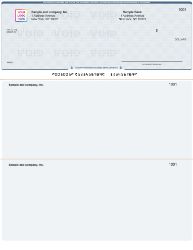
Quickbooks® Check on Top


Troubleshooting: Why Can't I Print Checks in QuickBooks Online

If you are having trouble printing checks in QuickBooks Online, one of these six issues is almost always the cause.


Problem 1: Check Does Not Appear in the Print Queue

Cause: The Print Later checkbox was not selected when the check was recorded.

Fix: Open the check from your register. Check the Print Later box. The Check No. field changes to "To Print." Save and close. The check now appears in the print queue.


Problem 2: PDF Does Not Open After Clicking Preview and Print

Cause: The browser's popup blocker is preventing the PDF from opening.

Fix: Look for a popup blocked notification in your browser address bar. Click it and allow popups from QuickBooks Online. Alternatively, click the PDF download link directly and open it manually in Adobe Acrobat Reader. Chrome and Firefox work most reliably for QuickBooks Online check printing.


Problem 3: Checks Print Misaligned Despite Completing Setup

Cause: Adobe Acrobat Reader is printing at a scale other than 100 percent.

Fix: Open the PDF in Adobe Acrobat Reader. Go to File, Print. In the Page Sizing and Handling section, select Actual Size. Never use Fit to Page or Shrink to Printable Area. These settings reduce output by 3 to 5 percent and shift all field positions regardless of how the QBO alignment grid is set.


Problem 4: Checks Print but Bank Rejects Them

Cause: The check stock does not have MICR encoding, uses non-certified toner, or has an incorrect routing number.

Fix: Order QuickBooks-compatible check stock from a manufacturer that pre-verifies routing numbers against the Federal Reserve E-Payments Routing Directory before printing. A routing number error or non-certified MICR toner causes bank reader-sorter machines to reject the check even if it prints correctly on paper. See our QuickBooks-compatible checks guide for check stock that meets these requirements.


Problem 5: "You Don't Have Permission to Print Checks" Error

Cause: The QBO user account does not have Print Checks permission enabled.

Fix: An admin needs to go to Settings, Manage Users, find the user's account, click Edit, and verify that the user has access to banking and expense functions including printing. Standard user roles in QuickBooks Online sometimes exclude check printing by default.


Problem 6: Checks Print Correctly but Numbers Are Wrong

Cause: The Starting Check No. entered in QBO did not match the first physical check loaded in the printer.

Fix: In QuickBooks Online, open each incorrectly numbered check, void it if it has not been issued, and reprint with the correct starting number. Going forward, always verify the number printed on the first physical check in the printer tray before entering the starting number in QBO.


Why MICR Check Stock Matters When You Print Checks in QuickBooks Online

Once you know how to print checks in QuickBooks Online, the software side is handled automatically. What determines whether the printed check clears your bank successfully is the quality of the check stock you use.


What MICR Means and Why Banks Require It

MICR stands for Magnetic Ink Character Recognition. The row of characters at the bottom of every check is the MICR line. It contains your ABA routing number, checking account number, and check number. Bank reader-sorter machines process checks by reading this line magnetically, not visually. For the magnetic reading to work, the MICR characters must be printed in certified iron oxide magnetic toner at the check manufacturing stage, not by your office printer.

When you print checks in QuickBooks Online, your printer adds the payee name, dollar amount, date, and other variable fields. The MICR line must already be on the check stock before it goes into your printer. Check stock without a pre-printed MICR line, or with a MICR line printed in regular office ink, will be rejected by bank reader-sorter machines. The check looks correct to the eye but fails bank processing.


Routing Number Verification Before Printing

A second MICR-related problem is an incorrect routing number on the check stock. Routing numbers change when banks merge, when accounts move between branches, and when regional routing assignments shift. A routing number that was correct when you last ordered check stock may no longer be current.

Checkomatic verifies every routing number against the Federal Reserve E-Payments Routing Directory before printing begins. This catches transposed digits and outdated routing numbers before they produce a full batch of checks that bank clearing systems reject. See our ABA routing numbers guide for how to verify your routing number before ordering.

For the complete explanation of computer check benefits and MICR requirements, see our guide on how to print checks with your computer using QuickBooks.


Why Choose Checkomatic for QuickBooks Online Check Stock

Pre-Calibrated to QuickBooks Online Print Templates

Checkomatic manufactures check stock sized and formatted to match QuickBooks Online's default print templates for all three formats: Voucher, Standard, and Wallet. This minimizes the alignment adjustment needed during the one-time setup step. Most users confirm alignment on the first or second test print.


MICR Pre-Verified Against the Federal Reserve Directory

Every routing number is verified against the Federal Reserve E-Payments Routing Directory before production begins. This catches transposed digits and outdated routing numbers before printing starts. Bank rejection rate for MICR-related issues at Checkomatic is under 0.1 percent across all orders.


In-House Manufacturing in Monroe, NY Since 1997

All QuickBooks-compatible check stock is manufactured at Checkomatic's own facility. No third-party print vendors. Direct manufacturing means lower prices, faster turnaround (3 to 5 business days standard), and a single accountable source for every order. Rush and overnight options are available for urgent printing needs. See shipping and handling for rush options.


Six Security Features at Base Price

Every QuickBooks-compatible check order includes chemically sensitive paper, microprinting, void pantograph, UV fluorescent fibers, heat-sensitive ink, and pre-encoded MICR at the base price. No security upgrade needed. For a full breakdown of why these features matter, see the benefits of using QuickBooks checks.


50 to 70 Percent Below Direct-From-Software Ordering

Ordering check stock directly through the QuickBooks interface routes your order through a third-party printer with retail markup. Checkomatic manufactures in-house with no middleman. Free black-and-white logo printing is included on every order. For pricing guidance and what to look for when choosing a supplier, see our QuickBooks compatible checks guide.
 

Jul 30, 2026

Personal vs Business Checks: Full Comparison Guide

Personal Check Definition and Business Check Definition

Personal check definition: a personal check is a check drawn against an individual's personal checking account, used for personal financial transactions. The check carries the account holder's name, address, and personal bank account information. It is issued in a wallet-size format designed for portability in a personal checkbook.

Business check definition: a business check is a check drawn against a business checking account, used for business financial transactions including payroll, vendor payments, accounts payable, operating expenses, and tax payments. The check carries the business name, address, and business bank account information, and is available in multiple formats designed for different business workflows.

The most fundamental difference between personal and business checks is the account from which each is drawn. Personal checks are drawn on personal bank accounts; business checks are drawn on business bank accounts. Both types clear through the same Federal Reserve check clearing system and process identically from the bank's perspective. The differences in size, format, and features are about functionality for the user, not about how the banking system processes the payment.


Size Comparison: Personal Check vs Business Check Dimensions

The personal check 6 inch dimensions: personal check size is 6 inches wide by 2.75 inches tall for the detached check. This personal checkbook wallet size format fits in a standard bi-fold checkbook cover and can be carried in a wallet or purse. The check pad holds 20 to 25 checks, and four to five pads make a standard personal checkbook box.

The business check size dimensions depend on the format. Business check 8.5 inch format: standard computer business voucher checks are printed on full 8.5-by-11-inch sheets. The check itself occupies one third of the sheet, measuring approximately 8.5 inches wide by 3.5 inches tall. The remaining two thirds of the sheet contains voucher stubs. Checkomatic confirms the standard sizes: personal check 6.00 inches by 2.75 inches; business voucher check 8.50 inches by 3.50 inches; business 3-on-a-page check 7.00 inches by 3.00 inches per check position on the sheet.

The size difference exists for a functional reason, not an arbitrary one. Business checks need to feed through a laser or inkjet printer connected to accounting software, sit flat on a desk for hand-signing, align with printer feed trays in accounting departments, and carry more information than a personal check (voucher stub fields, company logo, address, multiple signature lines). The larger 8.5-by-11-inch sheet handles all of these requirements in a way that a wallet-size personal check cannot.

Capital One's business guide notes: "Business checks are generally larger than personal checks, usually coming in at around 8 by 2 to 3 inches... The larger format of business checks allows space for details like your company name, logo and address."


Layout and Format Differences

Personal checks come in one basic layout in several style variations. The check fields (payee, amount, date, signature, memo) are always in the same positions. Style variations include standard top-tear, side-tear, top stub (spiral bound), and deskset formats, but the check face itself is always the same wallet-size layout. Personal check formats are described in detail in our types of checks guide.

Business checks come in six distinct layouts that serve different workflows:


  • Check on top (voucher): Check in the top third of the sheet, two voucher stubs below. The most common format for QuickBooks and most accounting software.


  • Check in middle: Check in the center third, one stub above and one below. Used with Sage 50 (Peachtree) and MYOB.


  • Check on bottom: Check in the bottom third with stubs above. Used with specific payroll and specialty software configurations.


  • 3-on-a-page: Three checks per sheet, no stubs. Maximum check output per sheet, used where remittance detail is sent separately.


  • Manual checks: 3-on-a-page format for handwriting, with pre-printed stub fields for accounts payable, payroll, or multi-purpose use.


  • Z-fold pressure seal: Full-page format that folds and seals without an envelope, used for high-volume mailed check operations.


The format selection is primarily driven by the accounting software a business uses and whether checks are printed through software or written by hand. This decision is covered in detail in our business checks and payroll guide.


Voucher Stubs: The Biggest Practical Difference

The presence or absence of voucher stubs is the most practically significant difference between personal and business checks, and it is consistently underemphasized in comparison guides.

Business checks in voucher, check on top, check in middle, and check on bottom formats include one or two detachable stubs attached to the check. These stubs contain pre-printed payment detail fields: invoice number, invoice date, gross amount, discount amount, net payment amount, and memo fields. When a business issues a payment:

  • The check tears away from the stubs and goes to the payee for deposit.


  • The payer keeps one stub as their accounts payable record.


  • A second stub may be sent to the payee as remittance advice, telling them exactly which invoices the payment covers.


This self-contained remittance data is the reason businesses choose voucher checks over wallet checks or ACH payments for vendor relationships with multiple open invoices. The payee receives both the payment and a document explaining what the payment covers, allowing immediate accounts receivable reconciliation without a separate phone call or email.

Personal checks have no stub of any kind. The only payment record on a personal check is the memo line, which holds brief free-text notes. For personal payments (rent, utilities, charitable donations, contractors), this is sufficient. For business payments with multiple invoices per vendor, it is not.

Manual business checks, which are handwritten rather than software-printed, include stub areas with the same payment detail fields. The payer fills in the relevant invoice and payment information by hand at the time of writing. See our business check voucher refill guide for a detailed explanation of how voucher stub fields work.


Security Feature Comparison

The business check security features vs personal check security features comparison is somewhat overblown in competitor content. Both types share the same ABA-compliant security paper specification, and the presence or absence of specific features depends far more on the check manufacturer than on the check type.

What is accurate: business checks often ship with more security features than entry-level personal checks from the same manufacturer because business check buyers tend to be more security-conscious, because the consequences of business check fraud are larger (higher transaction amounts, more checks per account), and because some business check manufacturers offer tiered security levels.

What is not accurate: the premise that personal checks inherently have fewer security features than business checks. At Checkomatic, both personal and business check formats ship on the same ABA-compliant six-feature security paper: chemically reactive paper, genuine watermark, microprinting, thermochromic ink, void pantograph, and UV fluorescent fibers. There is no security tier difference between Checkomatic's personal and business orders. Both include the full ABA security standard at base price.

The security features that are genuinely unique to some business check formats include additional signature lines (for dual-signature requirements), voucher stub serial numbering for internal audit control, and MICR-certified printing for high-volume automated processing. For the complete security feature breakdown, see our safe and security checks guide.


Accounting Software Compatibility

Business check accounting software compatible requirements are the most technically specific difference between personal and business checks, and they are entirely absent from personal check use.

When a business prints checks through QuickBooks, Sage, Xero, or another accounting platform, the software generates the check image (payee, amount, date, check number) and sends it to the printer. The printer applies this to the pre-printed check stock. A QuickBooks compatible business check must align with the software's print template exactly.

QuickBooks supports three print templates: Voucher (check on top), Standard (3-on-a-page), and Wallet (personal-size). If you print using the Voucher template, you must use check on top stock. If you use check in middle stock with the Voucher template, the check fields will be misaligned and the check will be unusable. This business check QuickBooks compatible alignment requirement drives the format selection for the large majority of small business check orders.

Sage 50 (Peachtree) uses check in middle as its default format. MYOB uses check in middle. These software-specific requirements mean a business switching accounting software may also need to change its check format and reorder stock. Personal checks have no equivalent software requirement; they are filled in by hand and do not feed through a printer in normal use.

For a complete guide to QuickBooks check format selection, see our QuickBooks checks page.


What Is Printed on Each Check Type

The pre-printed content on personal and business checks differs in three areas.


Name and Entity Type

Personal checks carry the individual account holder's full name. Business checks carry the business name, which may be the legal name, the DBA (doing business as) name, or both. For sole proprietors operating under their own name, the business check and the personal check may carry the same name; for any other business structure, the business name is different from the individual owner's name.


Address and Contact Information

Personal checks carry the account holder's home address. Business checks carry the business address. Some businesses also print a phone number, website, or email address in the payer information block. This additional contact information is standard practice in business check printing but rarely included on personal checks.


Logo

Business check logo printing is a standard feature that personal checks rarely include. A business logo printed in the upper left corner of a business check reinforces brand identity when the check is received by a vendor or employee, signals a professional, established business, and helps the payee identify and file the payment in their records. Free black and white logo printing is included on every Checkomatic business check order. Personal checks can also include a logo at Checkomatic, at no extra charge for black and white.


Cost Comparison: Personal vs Business Checks

The business check cost per check vs personal check cost comparison is one where the actual difference is smaller than most buyers expect.


Personal Check Cost

Cost of personal checks from a direct manufacturer like Checkomatic is approximately 15 to 25 cents per check depending on format and order quantity. Standard personal checkbooks in blue, burgundy, or green at typical order quantities fall in this range. Personal checks ordered through a bank typically cost $25 to $50 for 200 checks, or 12.5 to 25 cents per check, but bank pricing includes a significant markup over the actual manufacturing cost.


Business Check Cost

Cost of business checks from a direct manufacturer: computer checks run approximately 20 to 35 cents per check, reflecting the larger paper size, more complex layout, and voucher stub printing. Manual business checks run similarly. The per-check cost difference between personal and business checks from the same direct manufacturer is typically 5 to 10 cents per check.

Business checks ordered through a bank carry the same 50 to 100 percent markup that personal bank checks do. Checkomatic's page on business vs personal checks confirms: "The mistake is ordering business checks through your bank. Banks resell checks at a 50 to 100 percent markup. Order direct from a printer like Checkomatic and you'll pay close to personal-check pricing per unit."


The Real Cost of a Business Check Transaction

The per-check purchase price is only part of the cost of a business check transaction. Melio's analysis puts the aggregated cost of sending a single business check (including staff time to prepare, sign, mail, and reconcile, plus postage and banking fees) at $4 to $20 per check, substantially higher than the paper cost alone. ACH payments average $0.28 per transaction on the same all-in basis. This total-cost comparison is why many high-volume businesses migrate away from paper checks to ACH for routine vendor payments while retaining paper checks for specific situations requiring remittance documentation.


The MICR Line Is Identical Across All Check Formats

This is the one important technical fact that most personal vs business check comparison guides miss entirely. The MICR line same format: the MICR line (the machine-readable line at the bottom of every check containing the routing number, account number, and check number) is formatted identically on personal checks and all business check formats. The MICR line position, field structure, E-13B font, and MICR toner specification are all governed by ANSI X9.100 standards that apply equally to personal and business checks.

A bank's automated check processing system reads only the MICR line to process a check. It cannot tell from the MICR line whether the check is a personal check or a business check, a wallet check or a voucher check. All formats clear through the Federal Reserve's automated clearing system identically. Chase confirms: "Both types of checks generally take about two business days to clear, but this varies by financial institution."

This matters because it means there is no functional banking difference between clearing a personal check and clearing a business check. The differences are entirely at the user and workflow level, not at the banking system level. For a complete explanation of MICR line structure, see our check diagram and layouts guide.


When Personal Checks Are the Right Choice

Personal checks are the correct choice in these five situations.


All Non-Business Personal Payments

Personal check rent payments, utility bills, charitable donations, healthcare copays, contractor payments for personal home repairs, gifts, and any payment from your personal funds to any payee. These are the core use cases for personal checks, and no special consideration about business vs personal applies.


Sole Proprietors Writing Very Few Business Checks

A sole proprietor who writes two or three checks per month for minor business expenses from a combined personal-business checking account can use personal checks without significant risk, provided they maintain clear records. The legal liability exposure of a sole proprietorship is the same regardless of which check type is used because no corporate veil exists to pierce. However, even here, separate accounts and business checks are the better long-term practice.


Business Payments When Only Wallet-Size Is Practical

Some business contexts require a portable, wallet-size check: paying a contractor on site, writing a check at a trade event, or writing a check to an employee in a field service context. Checkomatic's QuickBooks wallet checks and manual pocket checks serve this use case. They are business account checks in wallet size, not personal checks, but they solve the portability requirement.


Early-Stage Businesses Before Business Account Setup

In the very early days of a business before a business checking account is established, using personal checks temporarily is common and generally acceptable. The period should be as short as possible, and retroactive accounting separation of business expenses from personal records is important for tax purposes.


Informal Personal Payments Within Families

Payments within a household or between family members (splitting a shared expense, reimbursing a family member, birthday gifts in check form) have no reason to involve business checks. Personal checks are always correct for these transactions.


When Business Checks Are Required

Business checks are required (or strongly indicated) in five situations.


Any Business with a Registered Legal Entity

The LLC check requirement: if your business is an LLC, a corporation, a partnership, or any registered entity, business checks are required for business expenses. The bank account from which business payments are made should be a business checking account in the entity's name, and the checks should carry the entity name. Using personal checks for a registered entity's expenses creates legal, tax, and liability risks described in the mixing section below.


Payroll Checks to Employees

Business check payroll payments must be drawn from the business payroll account, not a personal account. Employee payroll records, W-2 reporting, and payroll tax obligations are all tied to business accounts and business check payments. Checkomatic's manual payroll checks are specifically designed for this use with payroll-specific stub fields for gross pay, deductions, and net pay.


Vendor and Accounts Payable Payments

Business check accounts payable: vendor payments from a business should come from the business checking account so that the expense is clearly documented as a business expense in both the payer's records and the payee's records. The voucher stub attached to a business AP check provides the remittance detail that vendors need for accounts receivable reconciliation.


Payments Requiring Company Name on the Check Face

Some vendors, landlords, and government agencies require payment from the business entity and will not accept a personal check for a business obligation. Lease agreements for commercial space, business utility accounts, business insurance payments, and tax authority payments all typically require the business name on the check.


High-Volume Check Operations Requiring Accounting Software Integration

Any business using accounting software (QuickBooks, Sage, Xero, etc.) to print checks needs business check formats compatible with those software print templates. Personal checks are not designed for printer feed and do not align with accounting software templates. Using business computer check formats ensures accurate alignment, complete voucher stub printing, and MICR encoding that works with software-generated check numbers.


The Legal Risk of Using Personal Checks for Business

This is the most underemphasized point in most personal vs business check comparison guides, and it deserves detailed coverage because the consequences for LLC and corporate owners can be severe.


Piercing the Corporate Veil

The limited liability protection of an LLC or corporation (the "corporate veil") protects the owner's personal assets from business creditors. If a creditor sues your business and wins a judgment, they can collect from business assets but not from your personal bank accounts, car, or home. This protection only holds if the business is treated as a genuinely separate legal entity from its owner.

Piercing the corporate veil personal checks risk: using personal checks for business expenses is one of the specific behaviors courts examine when creditors argue that the corporate veil should be "pierced." If a court finds that you consistently used personal funds and personal accounts for business purposes, it may conclude that the business and the individual are effectively the same entity and allow the creditor to pursue your personal assets. Chase's guide explicitly flags this: "It is essential to avoid mixing your personal and professional expenses if you run your business as a limited liability company (LLC), because a creditor could potentially argue that you're personally liable for your company expenses."

Mixing personal and business checks can be used as evidence in this argument. It is not the only factor courts consider, but it is a documented and recognized one.


Tax Complications

Business check tax deduction separation: when business and personal transactions are mixed, tax preparation requires sorting each transaction individually to determine which are deductible business expenses and which are personal. This sorting process is time-consuming, error-prone, and increases the risk of missing legitimate deductions or incorrectly claiming personal expenses as business expenses. The IRS also views co-mingling as a red flag that can draw additional scrutiny to returns that mix the two.


Bookkeeping and Audit Readiness

Clean accounting requires that every business expense trace to a business account transaction. When business expenses appear in a personal account, reconciling accounting records to bank statements requires constant manual intervention to separate the two categories. If a business is audited or needs to present financial statements to investors, lenders, or acquirers, mixed personal-business accounts create an immediate credibility and documentation problem.


Sole Proprietor Check Choice

Sole proprietors occupy a unique position in the personal vs business check decision because they are legally the same entity as their business. There is no corporate veil to pierce because there is no separate legal entity for the business.

From a strict legal standpoint, a sole proprietor operating under their own name can use personal checks for business expenses without the piercing risk that applies to LLCs or corporations. The tax treatment is also more flexible because all sole proprietor income and expense flows through Schedule C on the personal tax return regardless of which account it comes from.

However, even for sole proprietors, using separate business accounts and business checks is strongly recommended for three practical reasons. First, tax preparation is dramatically simpler when all business transactions are in a dedicated account with business checks. Second, business check professional appearance matters: a contractor, freelancer, or consultant who pays business expenses from a check carrying their business name looks more established than one using a personal check. Third, growth planning: when a sole proprietor eventually forms an LLC or corporation (which most do as the business grows and liability exposure increases), having established check account separation from personal records makes the transition far cleaner.

For a sole proprietor who writes very few business checks and does not use accounting software, Checkomatic's personal check range serves the practical need while the business remains in the sole proprietor structure. As the business grows, transitioning to a dedicated business checking account with Checkomatic business check formats is the logical next step.


Business Check Format Selection Guide

For buyers who have decided they need business checks, the next decision is which format. Here is the selection guide by primary use case.


QuickBooks Desktop or Online, Standard Print

Order check on top (voucher). This is QuickBooks' default voucher template. The check prints in the top third, two stubs print below. If you have never changed your QuickBooks print settings, this is the format your software expects. Checkomatic's QuickBooks checks are tested for QuickBooks Desktop and Online alignment.


Sage 50 (Peachtree) or MYOB

Order check in middle. Sage 50's default print template places the check in the center of the sheet. Using check on top stock with Sage 50 produces misaligned output.


High-Volume Check Printing, No Stub Needed

Order 3-on-a-page checks. Three checks per sheet, no stubs, maximum check yield per box. Used when remittance data is sent separately or not required.


Handwritten Business Payments (AP, Payroll, or Both)

Choose from Checkomatic's manual check range: manual AP checks, manual payroll checks, multi-purpose checks, or compact deskbook checks. All store in a 7-ring binder for desk use.


High-Volume Mailed Checks (Payroll or AP Vendor Payments)

Order Z-fold pressure seal checks. Prints and folds to mail without an envelope. Eliminates folding, stuffing, and sealing for high-volume mailing runs.


Ordering Personal and Business Checks From Checkomatic

Checkomatic has manufactured personal and business checks in Monroe, NY since 1997. As an in-house check manufacturer (in-house check manufacturer), every order is produced at the Monroe NY facility with direct quality control over paper grade, MICR encoding, and security feature printing.


Full Personal Check Range

Personal check ordering range: all personal check formats with ABA-compliant security paper and a check register included with every order: personal checkbooks in blue, burgundy, or green (single or duplicate), top stub checks, deskset checks, and secretary deskbook checks.


Full Business Check Range

Business check ordering covers all six business check formats: check on top, check in middle, check on bottom, 3-on-a-page, the full manual business check range, and blank check stock for MICR printing operations.


Same Security Paper, Both Types

Every Checkomatic ABA compliant check, personal and business, ships on ABA-compliant security paper with all six fraud deterrent features at base price. CPSA certified confirmation appears on every order. No separate security tier is needed for either type.


Free Logo, Standard Turnaround

Free black and white logo printing is included on every personal and business check order. Standard turnaround is 3 to 5 business days from digital proof approval. Start at checkomatic.com.


The Short Version on Personal vs Business Checks

Personal checks are drawn from personal accounts, measure 6 inches by 2.75 inches, come in one wallet-size format, carry the individual's name, and include no voucher stubs. They are the right choice for all personal financial transactions and appropriate for sole proprietors with minimal business check activity.

Business checks are drawn from business accounts, measure 8.5 inches by 3.5 inches in voucher format, come in six formats for different workflows, carry the company name and logo, and include voucher stubs with remittance detail fields. They are required for LLCs, corporations, and any business using accounting software to print checks. Using personal checks for a registered business entity's expenses risks piercing the corporate veil, complicates tax preparation, and creates bookkeeping problems.

The MICR line that banks read to process a check is identical in format and specification across personal and business check formats. The banking system does not distinguish between them. All differences are at the workflow, documentation, and legal level, not at the payment processing level.


Frequently Asked Questions


What is the difference between personal and business checks?

Personal vs business checks comparison shows five concrete differences. First, size: personal check size dimensions are 6 inches by 2.75 inches (wallet size); business check size dimensions for voucher format are 8.5 inches by 3.5 inches per check on an 8.5-by-11-inch sheet. Second, layout: personal checks come in one format; business checks come in six formats (check on top, check in middle, check on bottom, 3-on-a-page, manual, Z-fold pressure seal). Third, voucher stubs: business check voucher stubs carry invoice numbers, payment amounts, and remittance details; personal checks have only a memo line. Fourth, software compatibility: business checks are designed for printer feed and alignment with QuickBooks, Sage, and other accounting software; personal checks are not. Fifth, what is printed: business checks carry the company name, logo, and business address; personal checks carry the individual's name and personal address. The MICR line structure is identical across both types.


Can I use personal checks for business expenses? (can i use personal check for business expense)

You can use personal checks for business in limited situations, but it is not recommended for any registered business entity. For LLCs and corporations, using personal checks for business expenses can be used as evidence to "pierce the corporate veil" and make you personally liable for business debts, because courts look for signs that the business and individual were not treated as genuinely separate entities. The tax complications from mixing accounts are also significant: every transaction must be individually sorted to separate personal and business expenses, increasing preparation cost and error risk. The professional appearance of a business check on vendor relationships is also meaningful. Sole proprietors without a separate business entity have less legal risk but still benefit practically from keeping business and personal finances separate.


Are business checks more expensive than personal checks?

Business checks cost slightly more per check than personal checks from the same direct manufacturer, typically 5 to 10 cents more per check, reflecting the larger paper size, more complex layout with voucher stubs, and additional features. From Checkomatic, personal checks run approximately 15 to 25 cents per check; business computer checks run approximately 20 to 35 cents per check. The per-check price difference is small. The larger cost difference between ordering through a bank versus ordering directly from a manufacturer like Checkomatic (banks mark up 50 to 100 percent) dwarfs the personal vs business type difference. The all-in cost of sending a business check (staff time, postage, reconciliation) averages $4 to $20 per check according to Bank of America's research, well above the paper cost.


What business check format should I order?

The right business check format depends on your accounting software and whether you print or write checks by hand. For QuickBooks (Desktop or Online) using the default settings, order check on top (voucher format). For Sage 50 or MYOB, order check in middle. For maximum check yield per sheet without stubs, order 3-on-a-page. For handwritten AP payments, order manual accounts payable checks. For handwritten payroll, order manual payroll checks. For high-volume mailed payments where you want to eliminate envelopes, order Z-fold pressure seal. If you are unsure of your QuickBooks print template, go to File, then Printer Setup, then select Check from the Form Name dropdown to confirm your current format setting before ordering.


Can a sole proprietor use personal checks for business?

A sole proprietor operating without a separate legal entity can legally use personal checks for business because the law treats the sole proprietor and the business as the same legal entity, so there is no corporate veil to pierce. However, sole proprietors benefit from separate business accounts and business checks for three practical reasons: simpler tax preparation (all business transactions in one place), better professional appearance with vendors and clients, and cleaner records when eventually forming an LLC or corporation. For sole proprietors who write very few business checks and do not use accounting software, Checkomatic's personal check formats serve the immediate need. As the business grows, transitioning to dedicated business check formats is the logical next step.

Jul 30, 2026

What Happens When a Check Bounces: Fees, Legal Risks, and What to Do

In This Guide:


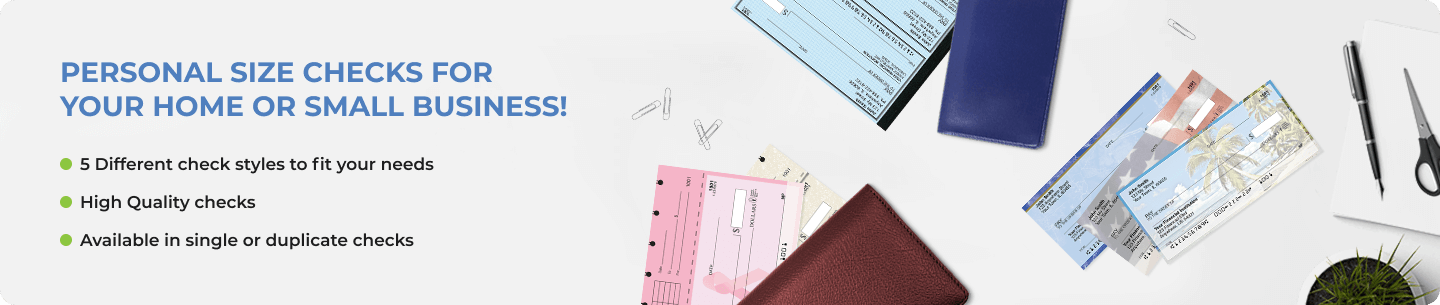
5 Different check styles to fit your needs, High Quality checks, Available in single or duplicate checks


What Happens When a Check Bounces: The Step-by-Step Process

What happens when a check bounces follows a predictable sequence. Understanding the path the check takes after it is rejected. The sequence is the same whether the check was written to a grocery store, a landlord, a utility company, or a friend.


Step 1: The Payee Deposits Your Check

After you write a check, the person or business receiving it deposits it at their bank. Under the Check 21 Act, banks process checks electronically. The payee's bank submits a request for payment to your bank, typically within one to two business days of deposit.


Step 2: Your Bank Checks Your Balance

Your bank receives the payment request and checks whether your account has sufficient funds to cover the check amount. If the balance is too low, the bank has two options: pay the check anyway through overdraft protection, or reject the check and return it unpaid.


Step 3: The Check Is Returned Unpaid

If your bank rejects the check, it sends a return notice to the payee's bank. The payee's bank reverses any credit it may have provisionally given the payee and notifies them that the check was returned. This is the moment the check officially "bounces." Your bank records the event on your account and charges an NSF fee.


Step 4: Both Parties Are Charged

Your bank charges you the NSF fee. The payee's bank may charge the payee a returned deposit fee for processing a returned item. The payee now has the original check back and is owed the full amount, plus whatever returned check fee they are allowed to charge under your state's law.


Step 5: The Payee Contacts You

The store, landlord, or individual contacts you by phone, letter, or both. They request payment of the original check amount plus their returned check fee. At this stage, paying promptly ends the matter for most payees. Delay is what triggers escalation to TeleCheck reporting, civil demand letters, and eventually legal action.


What Happens If My Check Bounces at a Grocery Store

What happens when a check bounces at a grocery store follows the same sequence as any returned check, with one additional consequence unique to retail. The grocery store scenario is one of the most common bounced check situations because people frequently pay for everyday groceries with a personal check without thinking carefully about their current account balance. Here is exactly what happens when a check bounces at a grocery store.


Immediate: The Store Is Notified

When a check bounces at a grocery store, the store's bank notifies the store that the check was returned unpaid, usually within two to three business days of deposit. The store's accounts receivable or customer service department records the returned check and contacts you.


The Store's First Contact

Most grocery stores make initial contact by phone or mail. They request payment of the original check amount plus their returned check fee, which varies by state but is typically $25 to $35. This first contact is the most important moment. Paying at this stage almost always ends the matter. The store recovers its money, you pay a modest fee, and no further escalation occurs.


Does the Grocery Store Try to Redeposit the Check?

Some grocery stores and banks attempt to redeposit a returned check once or twice before treating it as a definitive return. If your account now has sufficient funds, the redeposit succeeds and no further action is required. If the account is still short, the check bounces again and additional NSF fees apply. Grocery stores that use electronic check processing may attempt an electronic re-presentment automatically within a few days.


TeleCheck Reporting

Most major grocery chains participate in TeleCheck, a check verification network. When a check bounces and goes unpaid, the grocery store may report the event to TeleCheck. This places a mark on your TeleCheck record that can cause your checks to be declined at any other participating retailer, not just the original store. The TeleCheck system is real-time and is checked at the point of sale before your check is accepted. A TeleCheck decline is embarrassing and practically disruptive. Resolving the underlying debt and contacting TeleCheck directly is required to clear the record.


The Demand Letter

If you do not respond to initial contact, the grocery store or its collection partner sends a formal demand letter by certified mail. This letter states the amount owed, the returned check fee, and the deadline to pay (typically 30 days). It also notifies you that failure to pay within the deadline may result in civil legal action and, where applicable, criminal referral. Receiving this letter and ignoring it is the decision that converts a manageable financial mistake into a legal problem.


Civil Action and Criminal Referral

If you do not pay after receiving the demand letter, the grocery store can file a small claims court action seeking the original check amount plus civil damages, which in most states means two to three times the check face value. The store can also refer the matter to the local district attorney's bad check diversion program. Most DA offices give you another opportunity to pay before pursuing criminal charges, but ignoring multiple payment opportunities is what leads to charges.


What Is TeleCheck and How Does a Bounced Check Affect It

TeleCheck is a check verification and guarantee service used by thousands of retailers, grocery stores, drug stores, and other merchants across the United States. When you write a check at a store that uses TeleCheck, the cashier submits your check data to TeleCheck in real time before accepting it. TeleCheck evaluates your check-writing history and returns an authorization code or a decline code within seconds.


How TeleCheck Evaluates Your Check

TeleCheck uses two main codes: Code 3 (decline based on risk factors like unusual check patterns or insufficient verification data) and Code 4 (decline because you have an unpaid returned check or debt on file). A Code 4 is the one triggered by a bounced check that was not paid. Once you have a Code 4, your checks will be declined at any participating store until the underlying debt is resolved.


How to Resolve a TeleCheck Code 4

Resolving a TeleCheck Code 4 requires two steps. First, pay the original store the check amount plus the returned check fee. Get written confirmation of payment. Second, contact TeleCheck directly to dispute or clear the entry from your file. TeleCheck has a consumer resolution process. Provide them with proof of payment and request that the record be updated. Without the second step, your record may remain flagged even after the debt is paid. TeleCheck records can persist for up to five years if not addressed.


ChexSystems and Your Ability to Open Bank Accounts

ChexSystems is a consumer reporting agency that tracks banking history, specifically negative events like account closures, unpaid overdrafts, and check fraud. Most US banks use ChexSystems to screen applicants for new checking and savings accounts.

A single bounced check does not automatically create a ChexSystems record. What triggers ChexSystems reporting is when your bank closes your account as a result of repeated unpaid NSF events or a negative balance that remains unresolved for an extended period. Once a ChexSystems entry exists, many banks will deny your application for a new account, which can leave you without banking access for up to five years, the standard reporting period.

Preventing a ChexSystems entry is simple: pay any bounced check and associated fees before your account is closed. Once a record exists, disputing inaccurate entries through the ChexSystems consumer resolution process is the path to correction.


Does a Bounced Check Hurt Your Credit Score

A bounced check itself is not reported to Equifax, Experian, or TransUnion and does not directly lower your credit score. Banks and merchants do not report individual returned checks to the major consumer credit bureaus.

However, the indirect credit consequences can be significant. If a bounced check leads to an unpaid debt that is sent to a collection agency, that collection account is reported to the credit bureaus and can lower your credit score substantially. Late payment fees on bills paid by the bounced check can also result in negative credit reporting if the underlying account goes delinquent. The connection is indirect but real: a bounced check that spirals into a collection account can stay on your credit report for seven years.

Paying the bounced check and all related fees before the debt reaches a collection agency prevents any credit reporting impact entirely.


Civil Consequences

The bounced check consequences escalate in stages. Civil consequences apply when you fail to pay after receiving a formal written demand. Most states allow the payee to sue for the face value of the check plus statutory damages. The most common structure is treble damages, meaning the payee can recover two to three times the check amount as a civil penalty, subject to a state-set cap. Many states also allow recovery of the payee's court costs and collection expenses. Civil bad check actions are common in small claims court because the process is simple and the damages are clear.


Criminal Consequences

Criminal charges for a bounced check require proof of intent. An accidental overdraft caused by forgetting about a pending automatic payment or miscalculating a balance does not constitute a crime. Criminal bad check charges require proof that you knew the account lacked funds at the time you wrote the check and wrote it anyway.

Most states treat bad checks under $500 to $1,000 as misdemeanors. Checks over that threshold, or patterns of multiple bad checks, are charged as felonies in most jurisdictions. Many district attorney offices run diversion programs that give the check writer a chance to pay the full amount plus fees before criminal prosecution proceeds. Participating in the diversion program and paying within the deadline typically results in the matter being closed without a criminal record.


What to Do Immediately When Your Check Bounces

Speed is the most important variable when a check bounces. Every day you wait increases the likelihood of TeleCheck reporting, formal demand letters, and legal escalation. Here is the correct action sequence.

  1. Deposit funds immediately. The moment you learn a check has bounced, deposit enough money to cover the check amount plus your bank's NSF fee. This stops your account from going further negative if additional payments are still pending.
  2. Contact the payee the same day. Call the store or person who received the check. Explain that the check bounced and that you are resolving it immediately. Ask for the total amount owed including their returned check fee and how they would like the replacement payment (cash, money order, or debit card payment). Acting first before they come to you signals good faith.
  3. Call your bank and request a fee waiver. If this is your first bounced check, call customer service and ask them to reverse the NSF fee as a one-time courtesy. Banks routinely grant this for customers with solid account history. This works once per bank, typically.
  4. Pay the replacement amount immediately. Pay the original check amount plus the returned check fee in the payee's preferred method. Get written confirmation that the debt is paid in full. Keep this confirmation.
  5. Check your TeleCheck status if the bounce was at a store. If the check bounced at a retail store or grocery store, contact TeleCheck after paying to confirm whether the event was reported and request resolution if it was. Do not assume payment to the store automatically clears your TeleCheck record.
  6. Review your account balance process. Identify why the check bounced. Was it an unrecorded automatic payment? A miscalculated balance? An error in your check register? Fixing the root cause prevents the next bounce.


How to Prevent Bouncing a Check

Most bounced checks are not caused by poverty. Understanding the bounced check consequences teaches the same lesson: the problem is tracking, not funds. They are caused by poor tracking. A check written in good faith based on a mental estimate of the account balance, without accounting for pending automatic payments, outstanding checks, or recent deductions, bounces not because the money does not exist but because the tracking was wrong.


Use a Check Register Every Time

A check register records every transaction the moment it occurs, including automatic payments you know are coming. The running balance in the register reflects your true available funds, not your bank app balance, which excludes outstanding checks. This is the single most reliable way to prevent bouncing a check. See our check register guide for how to set one up and maintain it.


Reconcile Monthly

Monthly bank reconciliation compares your check register to your bank statement and identifies any discrepancies before they cause a bounce. The process takes 15 to 30 minutes. See our complete checkbook management guide for the full reconciliation process.


Set Up Low Balance Alerts

Most banks offer free text or email alerts when your account balance falls below a threshold you set. Set this threshold high enough to give yourself time to transfer funds before any pending payments clear. A $200 low balance alert on an account that typically runs near zero provides meaningful advance warning.


Use Overdraft Protection as a Safety Net, Not a Habit

Overdraft protection, linking a savings account or line of credit to your checking account, prevents checks from bouncing by covering shortfalls automatically. It does not eliminate fees, but it prevents the check from returning and all the downstream consequences that follow. Set it up as a last-resort safety net, not as a substitute for proper balance management.


Order Reliable Check Stock From a Verified Manufacturer

While bounced checks are usually caused by insufficient funds, some are caused by MICR encoding errors on the check stock itself. A check printed with an incorrect routing number or a MICR line encoded in non-certified toner carries a returned item fee risk from bank reader-sorter machines and may be rejected by bank reader-sorter machines even when the account has sufficient funds. Ordering personal checks or business checks from a manufacturer that pre-verifies routing numbers against the Federal Reserve E-Payments Routing Directory eliminates this risk entirely. For a complete explanation of check types and what each one is for, see our check types and terminology guide.


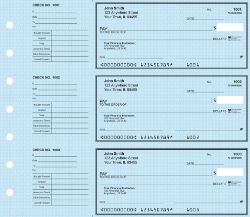
Personal Deskset Checks


Why Choose Checkomatic for Reliable Business and Personal Checks

MICR Pre-Verified Against the Federal Reserve Directory

Every routing number on every check order is verified against the Federal Reserve E-Payments Routing Directory before production begins. This catches transposed digits and outdated routing numbers before they produce checks that bank reader-sorter machines reject. MICR encoding errors are a preventable cause of check rejection that proper manufacturing eliminates.


In-House Manufacturing Since 1997

Checkomatic manufactures all personal and business checks at its own facility in Monroe, NY. No third-party print vendors. Direct manufacturing gives you a single accountable source for every order and eliminates the batch delays that come with reseller models.


Six Security Features at Base Price

Chemically sensitive paper, microprinting, void pantograph, UV fluorescent fibers, heat-sensitive ink, and pre-encoded MICR are included on every check order without a security upgrade. These features protect against check fraud, which is a separate concern from bounced checks but equally important for anyone writing checks regularly.


50 to 70 Percent Below Bank Pricing

Ordering from a direct manufacturer rather than through your bank saves 50 to 70 percent per order. Free black-and-white logo printing is included on every order. Volume discounts reduce the per-check cost further at higher quantities.


Jul 29, 2026

Advantages and Disadvantages of Personal Checks

Who Still Uses Personal Checks in 2025

Before diving into the advantages and disadvantages of personal checks, it is worth grounding the discussion in current data rather than assumptions about check decline.

Federal Reserve check usage data from the Federal Reserve Bank of Atlanta (Survey and Diary of Consumer Payment Choice, October 2024) found that one-third of US consumers had paid with a check in the previous 30 days. By bill payment value, check use fell from 23 percent in 2020 to 13 percent in 2024, consistent with a gradual shift to electronic methods but not an abandonment of checks. More than 90 percent of consumers reported preferring something other than a check for bill pay in 2024, yet one-third of them used a check anyway. This gap between preference and actual use suggests that practical factors (recipient requirements, lack of digital alternatives, size of payment) override preference in many check transactions.

The Vericast check survey 2025 (Paper Check Usage and Sentiment Survey, May 2025) provides the most important data point: 53 percent of respondents chose to use a check despite having digital alternatives available. Their stated reasons were recipient preference (33%), trust and security (29%), record-keeping (28%), and avoiding fees (24%). More than 80 percent of consumers maintained positive or neutral sentiment toward checks overall.

Understanding why people choose checks despite preferring digital alternatives is the starting point for understanding the real advantages of personal checks.


Advantages of Personal Checks

The advantages of personal checks cluster into two categories: financial advantages that save money or provide options that other payment methods do not, and documentation advantages that create records that other payment methods cannot match.


Advantage 1: Audit Trail and Legal Documentation

The personal check audit trail is the most important and most durable advantage of paper checks over every electronic alternative. When a check clears, your bank retains a digital image of both the front and back of the check. This image is accessible through online banking, typically for at least 7 years. The front shows the amount, date, payee, your signature, and the memo note. The back shows the payee's endorsement signature, the deposit information, and the clearing stamps.

This canceled check as proof of payment (the canceled check image) is legally admissible evidence of payment in disputes. If a landlord claims you did not pay your rent for a particular month, the canceled check image from your bank is the strongest possible proof of payment available to you. The image shows the landlord's signature endorsing the check, their bank's deposit stamp, and the clearing record. Court systems, government agencies, and creditors treat the canceled check as near-conclusive proof of payment because it carries both parties' signatures and the banking system's confirmation of the transaction.

Electronic payment methods like debit cards and ACH transfers generate records too, but those records show only that money left your account, not that it reached a specific payee in a specific transaction. A canceled check shows both that the money left your account and that the named payee received and deposited it with their signature on the back. Northwest Bank's analysis confirms: "Checks are the best way to prove that a lender, creditor, or government agency received payment."

This check legal documentation advantage is why checks remain the standard for payments where the relationship between payer and payee may later be disputed: rent, contractor work, healthcare bills, legal fees, and tax payments.


Advantage 2: Payment Timing Control

Payment timing control is the check float advantage that no other common payment method provides. When you pay by debit card, the funds leave your account within seconds. When you pay by ACH, the funds transfer within 1-2 business days. When you pay by credit card, the charge appears on your statement immediately and becomes due at the next billing date.

When you write a check, nothing happens to your account until the payee deposits it and it clears through the banking system. From the time you hand or mail a check to the time it debits your account, typically 1-5 business days pass depending on how quickly the payee deposits it and how the check processes through the system. This gap is the check float advantage.

The Federal Reserve Bank of Atlanta's research on small business check use notes float as a genuine operational advantage: "The time delay between writing a check and the funds leaving a bank account can be a form of short-term liquidity management. An additional day or two can be meaningful for smaller firms with a tight cash cycle or unpredictable inflows. Some small business owners take advantage of having the weekend to reconcile their books since a check written on Friday won't clear until Monday."

For individuals, the practical benefit is that a check written on Tuesday may not debit until Thursday or Friday, giving time for a paycheck or incoming deposit to clear first. This matters most for large, infrequent payments where the timing of the outflow relative to incoming funds is meaningful. Debit cards and instant ACH transfers remove this management window entirely.

It is important to note that intentionally writing checks you know will not clear is check fraud and is illegal. The float advantage is the legitimate use of the time between check issuance and clearing for funds management, not for buying time on a genuinely insufficient balance.


Advantage 3: The Stop Payment Option

The stop payment option is one of the most distinctive advantages of personal checks, and it is entirely absent from debit card payments. If you write a check and then need to cancel the payment before it clears (because the goods were not delivered, the service was not performed, a dispute arose, or you simply changed your mind), you can instruct your bank to block that specific check from being paid.

Stop payment fees typically range from $20 to $35 at most US banks, and the order is effective for 6 months under written request (UCC 4-403). For payments where a dispute is possible , a contractor deposit, a pre-authorized payment you want to cancel, a check that was lost in the mail , the stop payment option provides recourse that a settled debit transaction or wire transfer does not offer.

With a debit card transaction, once the payment posts and settles, you have limited recourse. You can file a dispute for unauthorized charges under Regulation E, but voluntarily authorized payments are difficult to reverse. A check in process that has not yet cleared can be stopped with a phone call and a fee. This stop payment advantage checks provides is one reason check writers specifically choose checks for large payments where recourse may be needed.

For the full guide to stop payments including duration, cost, and UCC rules, see our lost checks and replacements guide.


Advantage 4: No Interchange Fee

The no interchange fee checks advantage is the most significant financial benefit of checks for the payment recipient, and it is largely invisible to the person writing the check. When a business or individual receives a check, the full amount written on the check transfers to the payee's account with no percentage deducted by any payment network.

Credit cards trigger interchange fees of 1.5% to 3.5% on every transaction, paid by the merchant or recipient's bank. On a $1,000 payment, the credit card recipient nets $965 to $985 after interchange. A check for $1,000 delivers $1,000 to the payee with no deduction. This is why contractors, landlords, and small service providers often prefer or request checks for large payments: they receive the full amount they invoiced.

For the person writing the check, the cost structure is different: the check itself (15 to 25 cents when ordered from a direct manufacturer like Checkomatic) plus postage if mailed. Total cost per mailed check is under $1.00, with no percentage of the transaction amount. This makes the check the lowest-percentage-cost payment method for any payment above a few dollars. The no interchange fee advantage grows linearly with transaction size.

For a complete analysis of check vs card payment costs including actual interchange data from the Federal Reserve and AFP, see our card and check payments cost guide.


Advantage 5: Universal Acceptance

The check universal acceptance advantage: every bank in the United States accepts personal checks. No technology infrastructure, merchant account, app, or device is required on the payee's side to receive a check. A landlord, a babysitter, a tutor, a contractor, a neighbor, a government agency, and a nonprofit organization can all receive a personal check without any special setup.

Compare this to digital payment alternatives: Venmo, Zelle, PayPal, and Cash App all require both parties to have accounts on the same platform. ACH direct payment requires the payee to share banking credentials. Card payments require the payee to have a merchant account and processing equipment. Checks require nothing from the recipient except a bank account and the ability to endorse and deposit the check.

The universal acceptance advantage is especially relevant for person-to-person payments and payments to small businesses, sole proprietors, domestic workers, tutors, and others who serve individuals but do not have merchant payment infrastructure. The Vericast survey confirms that recipient preference (33% of respondents) is the most-cited reason people chose checks despite having digital alternatives available.


Advantage 6: Post-Dating Capability

The check post-dating advantage allows you to write a check with a future date, signaling to the recipient that you intend the payment to be applied on a specific future date. This can be useful for structured payment agreements, for ensuring a check is not deposited before a paycheck clears, or for scheduling the timing of a payment to a specific date.

Northwest Bank describes this as a check working "like a contract, stating that the person the check is written out to is to be paid the specified amount on the date noted on the check."

One important caveat: post-dating does not legally prevent a bank from processing a check before the written date, as noted in the check diagram guide above. Most banks process checks based on the MICR line and do not routinely review the date. If you need to ensure a check is not processed until a specific date, place a stop payment with your bank set to expire on that date and notify the payee of the arrangement. The post-dating is an informal signal that carries no guaranteed legal enforcement without additional steps.


Advantage 7: Spending Awareness and Budgeting

The check record keeping advantage that gets the least attention is the budgeting discipline that comes from writing checks and maintaining a check register. Every check transaction requires you to: write the amount in words and numbers, sign the check, record the transaction in the check register, and subtract from the running balance. This multi-step physical process creates more deliberate awareness of each expenditure than a card tap or phone payment does.

Vericast's 2025 survey found that record-keeping (28% of respondents) was a leading reason consumers chose checks over digital alternatives. The check register, whether the paper booklet included with every Checkomatic personal check order or an electronic equivalent, provides an immediate running balance of your account that is separate from your bank's posted balance. The register shows checks that have not yet cleared, giving you a more accurate picture of your true available balance than your bank statement alone. For a detailed guide to check register use, see our checkbook register guide.


Disadvantages of Personal Checks

Honest coverage of personal check disadvantages means discussing the real costs, risks, and limitations without minimizing them. Each disadvantage below is described with current data and, where applicable, how it can be mitigated.


Disadvantage 1: Bounced Check Fees

The personal check bounced check fee is the most immediate and most expensive disadvantage for people who do not carefully track their checking account balance. A bounced check (returned for insufficient funds) triggers fees that can compound quickly from multiple sources.

The payer faces an NSF fee check (non-sufficient funds fee) from their bank. According to Bankrate's 2025/2026 Checking Account Study, the average NSF fee has fallen to a record low of $16.82, down for the fourth consecutive year as regulatory pressure and competitive dynamics have pushed many banks to reduce or eliminate these fees. Capital One, Bank of America, Citibank, and Wells Fargo have all eliminated NSF fees since 2021. However, among banks with more than $10 billion in assets that still charge NSF fees, the median remains $32 as of early 2024.

The bounced check cost payer payee dynamic means both parties incur costs. The payer owes the original payment amount (now unpaid) plus the NSF fee. The payee may be charged a deposited item returned fee by their own bank. If the bounced check was paid to a business, many states permit the merchant to charge a returned check fee up to $30-$40. In some states this fee can reach $40, and multiple fees on the same incident can compound significantly.

The payee also experiences the inconvenience of an unpaid transaction and must contact the payer for payment, which can damage a landlord-tenant, contractor-client, or personal relationship. The payer may also face reporting to ChexSystems, a consumer reporting agency for banking history, which can affect the ability to open new checking accounts if a bounced check pattern develops.

The mitigation for this disadvantage is disciplined check register use. Recording every check in the register immediately after writing it and subtracting the amount from the running balance, before the check clears, prevents the situation where your bank's posted balance appears to show funds that are actually committed to outstanding checks. See our check register guide for exactly how this works.


Disadvantage 2: Mail Theft and Check Washing Risk

The check mail theft risk is the most serious security disadvantage of personal checks, and it is one that has worsened with organized mail theft operations targeting USPS collection boxes and residential mailboxes specifically to intercept checks.

A stolen mailed check can be subjected to check washing (chemical solvent removal of ink from the check while leaving the paper and signature intact) followed by alteration of the payee name and amount. This is an active fraud method. The Federal Reserve Bank of Atlanta and AFP fraud surveys confirm check fraud remains the most common payment fraud type, affecting 63% of organizations in 2024 (58% in 2025 per the 2026 AFP survey).

The check security risk from mail theft is mitigated by two practices: using ABA-compliant security paper with chemically reactive coating (which stains permanently and visibly when washing solvents contact it) and dropping mailed checks directly at a USPS post office counter rather than in a street collection box or residential mailbox. Both practices together dramatically reduce the viability of check washing as a fraud avenue. The security paper does not prevent theft but makes successful washing much harder. For a full guide to check washing and how security paper prevents it, see our check fraud scams guide.


Disadvantage 3: Routing and Account Number Exposure

The account number exposed check is a fundamental security disadvantage of paper checks. Every check you write displays your routing number and account number in the MICR line at the bottom, plus your name and address in the upper left. This combination of information is sufficient for an unauthorized person to initiate ACH withdrawals from your account, create counterfeit checks, or commit identity theft.

Northwest Bank explicitly identifies this risk: "When you give someone a check, you are providing them with your account number, name, and contact information on the check. A check payment can also be used to begin electronic debits which give the merchant greater access to the payee's bank account to make unauthorized but legal debits."

The mitigation is choosing payees carefully, using ABA-compliant security paper that makes counterfeiting harder, monitoring your account regularly for unauthorized transactions, and setting up account monitoring alerts with your bank. The routing number exposed on a check is the same for all accounts at your bank, so it is not account-specific; the combination of routing number plus account number is what enables unauthorized access.


Disadvantage 4: Processing and Clearing Delay

The check processing time is a genuine disadvantage for recipients who need immediate access to funds. Unlike real-time debit card payments that settle almost instantly for the merchant, a deposited check typically takes 1-5 business days to clear fully. The first $225 of a check deposit is usually available the next business day; larger amounts may have holds applied, particularly for new account holders or checks from non-local banks.

The check clearing time disadvantage affects both the payee (who must wait for funds) and the payer-payee relationship (where the payee may not trust that the check will clear). For time-sensitive payments where immediate availability of funds matters to the recipient, electronic payments are preferable.

From the payer's perspective, the processing delay is actually an advantage (timing control as described above). It is primarily a disadvantage for the payee who is waiting for funds.


Disadvantage 5: Declining Retail Acceptance

The check declining acceptance retail reality is that grocery stores, gas stations, fast food outlets, pharmacies, and most large general retailers no longer accept personal checks. The practical and security reasons are clear: check processing at retail is slower than card payment, the merchant cannot instantly verify funds, and a bounced check requires the merchant to pursue the customer for payment.

A 2024 Federal Reserve Bank of Atlanta data series shows check use for in-person purchase declined to a negligible fraction of retail transactions. Most large retailers switched to card-only or cash-and-card policies years ago, and the transition to contactless payments has accelerated this trend.

This disadvantage is situational: for rent, contractors, healthcare, charitable donations, and person-to-person payments, checks remain widely accepted. For grocery runs and gas fillups, checks are largely not accepted. Understanding where checks are and are not accepted is the key to matching the payment method to the context.


Disadvantage 6: The 6-Month Stale Check Rule

This is the disadvantage that almost no guide covers, yet it creates real problems for both check writers and recipients. Under UCC Article 3 and standard banking practice, a personal check presented more than 6 months (180 days) after its issue date is considered stale, and banks are not obligated to honor it.

The check stale after 6 months rule means that if you write a check and the recipient does not deposit it for more than 6 months, the bank may legally refuse to pay it even though you have sufficient funds in the account. Some banks decline to pay stale checks automatically; others pay them at their discretion but are not required to.

This matters in practice when: a check sent to a supplier gets lost in their accounts receivable pile for several months before being discovered and deposited; a charitable donation check gets bundled with a large batch of year-end donations and is not processed for months; or a check to an individual gets forgotten and resurfaces much later. From the payer's perspective, a stale check that the bank refuses to pay leaves the original obligation unpaid. From the payee's perspective, a stale check may be rejected at deposit, requiring the payer to issue a new check.

The mitigation is to place an expiration notice on checks you issue ("VOID AFTER 90 DAYS" printed in the check's security area) to manage the outstanding obligation window. For the check recipient, the best practice is to deposit checks promptly rather than letting them accumulate.


Where Personal Checks Still Dominate in 2025

The consumer sentiment data makes clear that checks are not disappearing; they are concentrating in the payment contexts where their advantages are most meaningful.


Rent and Housing Payments

Where checks still dominate: rent payment check is one of the most common check uses. Many landlords, particularly individual landlords and smaller property management companies, prefer paper checks for rent payments because: they provide a check paper trail advantage: a documented paper trail for their records, they avoid the processing fees that digital rent payment platforms charge, and they are familiar and manageable without any software investment. The Federal Reserve Bank of Atlanta data confirms rent/housing as a top check use category by payment value.


Contractor and Home Service Payments

Contractor payment check remains standard for home repair, landscaping, plumbing, electrical, cleaning, and other service provider payments. Contractors often prefer checks because they avoid the 2-3% card processing fee on their full invoice amount. The homeowner prefers a check because the canceled check image provides proof of payment with the contractor's endorsement signature, which is valuable documentation for home improvement tax deductions or sale disclosures.


Charitable Donations

Charitable donation check is the format most charities prefer from individual donors. A check delivers the full donated amount with no interchange deduction, unlike a card donation where the charity pays 2-3% to the card network. The check memo line can specify the fund or project the donation supports. The canceled check provides the donor with documentation for tax deduction purposes that is more explicit than a card transaction record.


Healthcare and Medical Copays

Many doctor's offices, dental practices, and medical billing departments still accept and prefer checks for copays and balances. The check amount matches the statement exactly with no rounding, and the patient has a documented payment record for their health records. Some practices charge a convenience fee for card payments that makes the check clearly cheaper.


Person-to-Person Payments

Payments to individuals who do not have mobile payment apps (older family members, domestic workers, tutors, babysitters, neighbors) remain a strong check use case. The check requires nothing from the recipient except a bank account. Venmo, Zelle, and Cash App all require the recipient to have the same platform or at least a compatible account. A check works for anyone with a checking account.


How Checkomatic Addresses Each Disadvantage

Every listed disadvantage of personal checks has a specific mitigation, and Checkomatic's products and practices address the security-related ones directly.


Mail Theft and Check Washing Risk

Every Checkomatic personal check ships on ABA-compliant security paper with chemically reactive coating, genuine watermark, microprinting, thermochromic ink, void pantograph, and UV fluorescent fibers. The chemically reactive coating is the direct countermeasure to check washing: any chemical solvent applied to the check creates a permanent, visible stain that makes the alteration immediately detectable. This turns the primary mail theft method from a viable fraud into a self-defeating attack that marks the check as tampered before it reaches a teller.


Routing and Account Number Exposure

The void pantograph, microprinting, and genuine watermark features on Checkomatic's security paper make counterfeiting checks using the exposed account information much harder. A fraudster who notes your routing and account number from a check cannot easily produce convincing counterfeit checks from Checkomatic security paper because they cannot reproduce the embedded watermark, the microprinted signature line, or the thermochromic response.


Bounced Check Risk

Checkomatic includes a check register with every personal checkbook order. The register is the simplest tool for preventing bounced checks: every check written is recorded immediately, the amount subtracted from the running balance, and the balance compared against the account before writing another check. For a complete guide to check register use, see our check register guide.


Check Ordering Cost

Ordering checks from Checkomatic costs significantly less than ordering through your bank. Bank-issued personal checks commonly run $25-$50 for 200 checks. Checkomatic's direct-manufacturer pricing delivers the same ABA-compliant security paper at a fraction of the bank cost. See our cheap checks online guide for the cost comparison.


Why Order Personal Checks From Checkomatic

Checkomatic has manufactured personal checks in Monroe, NY since 1997. As an in-house check manufacturer (in-house check manufacturer), every order is produced at the Monroe NY facility with direct quality control.


Full Personal Check Range

Every format of personal check is available: standard personal checkbooks in blue, burgundy, and green (single or duplicate); top stub personal checks for those who prefer the stub-above format; personal deskset checks for desk use; and secretary deskbook checks. A check register is included with every personal checkbook order.


ABA Security Features Address the Main Disadvantage

The main security disadvantage of personal checks, mail theft and check washing, is directly addressed by the six ABA fraud deterrent features on every Checkomatic check. ABA compliant check paper is confirmed by CPSA certified status, which confirms the security paper meets the Check Payment Systems Association's enhanced security standard. The CPSA padlock certification appears on every order.


Free Logo and Standard Turnaround

Free black and white logo printing on personal checks is included with every order. Standard turnaround is 3 to 5 business days from digital proof approval. ABA compliant (ABA compliant) MICR encoding is certified on every check. No pre-selected add-on programs appear at checkout.

Start your personal check order at checkomatic.com.


The Short Version on Advantages and Disadvantages of Personal Checks

Personal checks have seven real advantages: audit trail (canceled check image is legally strong payment proof), payment timing control (float between issuance and clearing), stop payment option ($20-$35 to block a specific check), no interchange fee (payee gets the full amount), universal acceptance (no merchant infrastructure needed), post-dating capability, and budgeting awareness from manual tracking. They also have six real disadvantages: bounced check fees (NSF average $16.82 per Bankrate 2025/2026, some banks still charge $32), mail theft and check washing risk, routing and account number exposure on every check, 1-5 day clearing delay, declining acceptance at retail, and the 6-month stale check rule that many people do not know exists.

Checks still used 2024 2025: in 2025, one-third of US consumers paid by check in the previous 30 days, and 53% chose a check over digital alternatives when both were available. Checks remain the dominant payment method for rent, contractors, charitable donations, healthcare, and large person-to-person payments where documentation, no interchange, and the stop payment option matter most.


Frequently Asked Questions


What are the main advantages of personal checks?

The personal check advantages list includes seven key benefits. First, the personal check audit trail: a canceled check image with both parties' signatures is the strongest proof of payment available, more legally defensible than a card transaction record. Second, payment timing control: checks do not debit your account until deposited and cleared (1-3 days typically), providing float that debit cards do not. Third, the stop payment option: for $20-$35, you can block a specific check from clearing if needed, a feature unavailable for settled debit transactions. Fourth, no interchange fee: the payee receives the full written amount with no percentage deducted by a payment network, unlike credit cards that charge 1.5-3.5%. Fifth, universal acceptance: any payee with a bank account can receive a check without apps or merchant accounts. Sixth, post-dating capability. Seventh, check record keeping advantage through manual register tracking that builds spending awareness.


What are the main disadvantages of personal checks?

The personal check disadvantages list includes six key drawbacks. First, bounced check fees: NSF fees averaging $16.82 (Bankrate 2025/2026) plus potential merchant fees up to $40 and ChexSystems reporting. Second, check mail theft risk: mailed checks can be stolen and washed, and the check security risk from exposed account information is real. Third, routing number and account number exposed on every check, enabling potential ACH fraud. Fourth, check processing time of 1-5 business days for full clearance, slower than electronic alternatives. Fifth, check declining acceptance retail: most grocery stores, gas stations, and large retailers no longer accept personal checks. Sixth, the 6-month stale check rule: banks are not obligated to honor checks presented more than 180 days after their date, which can complicate delayed deposits.


Do people still use personal checks in 2025?

Yes. The Federal Reserve Bank of Atlanta's October 2024 data found one-third of US consumers paid by check in the previous 30 days. The Vericast Paper Check Usage and Sentiment Survey (May 2025) found 53 percent chose checks despite having digital alternatives. The top reasons were recipient preference (33%), trust and security (29%), record-keeping (28%), and avoiding fees (24%). More than 80 percent of consumers maintained positive or neutral sentiment toward checks. Checks are used most for rent, contractor payments, charitable donations, healthcare, and large person-to-person payments where their documentation and no-interchange advantages matter most. Retail check use has declined substantially; check use for payment contexts requiring documentation and trust has remained more stable.


What happens when a personal check bounces?

When a personal check bounces for insufficient funds, the payer typically faces an NSF fee from their bank. According to Bankrate's 2025/2026 Checking Account Study, the average NSF fee is $16.82, though banks with more than $10 billion in assets that still charge NSF fees had a median of $32 as of early 2024. If overdraft protection covered the check, an overdraft fee averaging close to $35 applies instead. The payee may be charged a deposited item returned fee by their own bank. If the payee is a business, many states permit a returned check fee up to $30-$40. The payer still owes the original amount and may be reported to ChexSystems if bounced checks become a pattern. Maintaining a current check register is the primary prevention tool.


What are personal checks best used for today?

Personal checks remain the preferred payment method for specific contexts in 2025: rent payments (landlords who prefer paper records or do not accept digital apps without surcharges), contractor and home service payments (full amount delivered with documented payment record), charitable donations (full amount reaches charity without interchange deduction), healthcare copays and medical bill payments, person-to-person payments to individuals without mobile payment apps, court fees and government agency payments, and large personal transactions where documentation and no interchange matter more than convenience. The Federal Reserve Bank of Atlanta confirms that consumers are more likely to use checks for higher-dollar-value payments. The Vericast 2025 survey found recipient preference as the single strongest driver of check use despite digital alternatives being available.


Jul 29, 2026

What Is the Best Place to Order Checks Online: Complete Buyer Guide


Bank vs Online: Which Is the Best Place to Order Checks

When asking what is the best place to order checks online, most people assume the answer is their bank because it feels like the obvious choice. Your bank already has your account information, so the process seems simpler. In practice, ordering through your bank typically costs two to three times more than ordering from a direct online manufacturer, with longer turnaround times and fewer customization options.

Here is why the gap exists. Banks do not print checks. They send your order to a third-party printer on their behalf, mark up the price, and pass the order back to you with standard shipping. The bank takes a margin on every order. A direct manufacturer like Checkomatic handles the entire process in-house, from printing to MICR encoding to shipping, with no middleman markup.


What Type of Checks Do You Need Before You Decide Where to Order

The best place to order checks online depends partly on what kind of checks you need. Different check types have different format requirements, and not every online check supplier offers every type.


Personal Checks

Personal checks come in checkbook format, top stub format, or deskset format. If you write personal checks occasionally for rent, utilities, or personal payments, any CPSA-certified supplier handles this. If you want your logo or a custom design on personal checks, confirm the supplier offers that customization before ordering. Browse Checkomatic's options at personal checks.


Personal Top Stub Checks


Business Checks

Business checks divide into computer checks (printed through accounting software) and manual checks (handwritten). For computer checks, the format must match your accounting software's print template exactly. For manual checks, the format must fit your binder system. The best place to order business checks online is a supplier that confirms format compatibility before shipping and offers custom formatting at no extra charge. Browse business checks at Checkomatic.


Picture for category Manual Business Checks


QuickBooks Compatible Checks

QuickBooks checks require a specific layout so the software's print output lands in the correct position on the check stock. The three formats are voucher (check on top, the QuickBooks default), standard 3-on-a-page, and wallet. Ordering the wrong format means every check in the batch is unusable. The best place to order QuickBooks checks online is a manufacturer that calibrates check stock to QuickBooks print templates. See QuickBooks checks.

Quickbooks Checks 3 on a page


Laser and Computer Checks

Laser checks are printed by a laser or inkjet printer connected to accounting software. The check stock comes pre-printed with your company information and MICR line; your printer adds the variable payment details. Laser checks work with QuickBooks, Quicken, Sage, MYOB, Xero, and over 500 other platforms. See computer checks.


Computer Checks on Bottom


Manual Business Checks

Manual checks are handwritten. They come in 3-on-a-page binder formats with detachable stubs for accounts payable and payroll records. No printer or software required. Best for businesses processing fewer than 20 payments per month or for field payments where a printer is not available. See manual checks.

Manual Pocket Business Checks


Seven Factors That Define the Best Place to Order Checks Online

Not all online check suppliers are equal. Knowing what is the best place to order checks online means evaluating every supplier against these seven criteria before entering your banking information.


Factor 1: CPSA Certification

One key signal when determining what is the best place to order checks online is CPSA certification. The Check Payment Systems Association (CPSA) is the industry body that certifies check printers meeting the minimum security standard required under ANSI X9.100-170. A CPSA-certified printer is authorized to print the padlock icon on their check stock, which signals to banks and businesses that the checks meet verified security requirements. If a check supplier does not mention CPSA certification anywhere on their website, the security claims on their check stock are unverified assertions, not certified facts.


Factor 2: In-House Manufacturing vs Order Brokering

Some online check websites are order brokers, not manufacturers. They take your order, send it to a third-party printer, mark up the price, and ship it to you. You pay an extra margin for the intermediary without getting any additional benefit. A direct manufacturer like Checkomatic handles the entire process in-house: printing, MICR encoding, quality control, and shipping. Direct manufacturing gives you lower prices, faster turnaround, and a single point of accountability if anything goes wrong.


Factor 3: MICR Pre-Verification

The MICR line at the bottom of every check must be printed in certified magnetic toner for bank reader-sorter machines to process correctly. A wrong routing number or wrong account number in the MICR line produces a batch of checks that bank clearing systems reject. The best place to order checks online verifies your routing number against the Federal Reserve E-Payments Routing Directory before production begins, not after. This catches transposition errors and outdated routing numbers before they waste your check order.


Factor 4: Accounting Software Compatibility

If you print checks through QuickBooks, Quicken, Sage, MYOB, or another accounting platform, the check stock you order must match your software's print template exactly. Format mismatches cause every check to print misaligned, rendering the entire batch unusable. The best place to order checks online for software users is a manufacturer that carries pre-calibrated stock for major platforms and offers custom formatting for less common software at no extra charge.


Factor 5: Security Features in the Check Stock

Check fraud affects a significant portion of US businesses annually. The security features in your check stock are the primary defense against check washing, counterfeiting, and unauthorized alteration. At minimum, look for chemically sensitive paper, microprinting, and a void pantograph. The best suppliers include all six CPSA security categories at the base price without requiring a security tier upgrade.


Factor 6: Turnaround Time and Rush Options

Standard turnaround varies significantly between suppliers. Bank-issued checks take 7 to 14 business days. Direct manufacturers typically deliver in 3 to 5 business days. For urgent needs, look for a supplier that offers same-day production (Rush) and overnight delivery of an initial batch (SuperRush). Payroll deadlines and end-of-month AP runs do not wait for slow suppliers. See Checkomatic's delivery options at shipping and handling.


Factor 7: Reprint and Returns Policy

Check printing errors happen. A missing digit in your account number, a misspelled business name, or a wrong starting check number produces a batch you cannot use. Before you order, confirm the supplier's policy on errors: do they require proof that the error was theirs, or do they handle corrections regardless of who made the mistake? A supplier that reprints at cost of shipping for errors they verified is more reliable than one that requires extensive dispute processes.


What CPSA Certification Means and Why It Matters

The CPSA padlock icon on check stock is not a design element. It is a certification mark that tells anyone handling the check that the paper was manufactured by a CPSA-authorized printer to ANSI X9.100-170 security specifications. Banks and accounts payable teams recognize the padlock as a signal that the check includes verified fraud deterrent features across four categories: overt protection (visible to the naked eye), covert protection (visible only under special conditions), anti-copy features (degrading on reproduction), and anti-alteration features (making tampering visible).

A check without the CPSA padlock may still be legally valid, but it has not been verified to meet the industry's minimum security standard. For businesses processing regular payroll or vendor payments, the padlock is a baseline requirement, not an optional upgrade.


Why MICR Pre-Verification Separates Good Suppliers From Bad Ones

MICR stands for Magnetic Ink Character Recognition. The MICR line is the row of characters at the bottom of every check that bank reader-sorter machines read magnetically to identify the routing bank, the account number, and the check number for automatic processing.

The routing number in the MICR line must be printed in certified magnetic iron oxide toner, and it must be the correct current routing number for your bank. Routing numbers change when banks merge, when accounts are moved between branches, and when regional routing assignments shift. A routing number that was correct three years ago may not be current today.

The best place to order checks online verifies your routing number against the Federal Reserve E-Payments Routing Directory before any printing begins. This verification step catches:

  • Transposed digits (common data entry error)
  • Outdated routing numbers from bank mergers
  • Wrong routing numbers submitted for the account type
  • ACH routing numbers submitted instead of check routing numbers (these differ at some banks)

For more on routing numbers and how to verify yours, see our ABA routing number guide.


Software Compatibility: The Factor Most Buyers Forget

Software compatibility is the factor most buyers overlook when deciding what is the best place to order checks online. Buyers who handwrite their checks can order from most CPSA-certified suppliers and the stock will work. Buyers who print checks from accounting software face an additional requirement: the check stock must match their software's print template exactly.

Accounting software like QuickBooks, Quicken, Sage, and MYOB generates a print job that places each variable field (payee name, dollar amount, date, memo) at a specific pixel position on an 8.5 x 11 inch page. If the physical check stock positions the check, stubs, or fields at different locations than the template expects, every field prints in the wrong location.

The result is a complete batch of unusable checks. Payee names print over the signature line. Dollar amounts print on the stub. The date lands below the MICR area. None of these checks can be corrected after printing. They must be discarded and the entire order replaced.

The best place to order checks online for software users is a manufacturer that:

  • Carries pre-calibrated check stock for major platforms (QuickBooks Desktop and Online, Quicken, Sage 50, Sage 300, MYOB, Xero)
  • Offers custom formatting for less common software at no extra charge
  • Can confirm which format your specific software version uses before you order
  • Ships check stock sized to match the software's default print template

Checkomatic formats checks for QuickBooks Desktop (Pro, Premier, Enterprise, Accountant), QuickBooks Online, Quicken, MYOB, Sage 50 and Sage 300, Microsoft Money, Peachtree, and over 500 other platforms. If your software is not listed, custom formatting is available at no extra charge.


Security Features to Look For When Ordering Checks Online

When evaluating where to order checks online safely, the security features built into the check paper are one of the most important factors. Paper-level security features cannot be replicated by a copier or standard printer. They are the primary physical defense against the most common forms of check fraud.


Chemically Sensitive Paper

The check paper contains chemical compounds that produce visible, permanent staining when washing solvents (acetone, bleach, alcohol) contact the surface. Check washing, where a fraudster uses solvents to remove the printed payee name and amount before rewriting the check, leaves an irreversible chemical stain on this paper that cannot be concealed or overprinted.


Microprinting

Text printed at under one point size runs along the signature line and borders. To the naked eye it looks like a decorative line. Under magnification it reads as text. Any attempt to reproduce the check by photocopying or scanning degrades the microprinting to an unreadable blur, immediately identifying the copy as non-original.


Void Pantograph

A hidden background pattern causes the word VOID to appear prominently across the face of the check when it is photocopied or scanned. The original check shows nothing unusual under normal lighting. Any copy or scan immediately reveals the pattern.


UV Fluorescent Fibers

Fibers embedded in the check paper during manufacturing glow under ultraviolet light. Bank authentication equipment uses UV scanners to verify genuine check stock. These fibers are in the paper structure and cannot be replicated by any standard printing process.


Heat-Sensitive Ink

A thermochromic icon disappears when pressed with a finger and returns when it cools. Genuine checks respond to heat. Photocopies do not. Bank tellers and business owners can verify authenticity in seconds without special equipment.


Pre-Encoded MICR

The MICR line is pre-encoded in certified magnetic iron oxide toner at manufacture. Bank reader-sorter machines detect this magnetically. Counterfeit checks printed in standard office toner produce no magnetic signal where one is expected, causing immediate flagging.

Checkomatic includes all six of these security features at the base price on every check order. No security tier upgrade is required to reach meaningful fraud protection.


Five Red Flags When Choosing Where to Order Checks Online

Red Flag 1: No CPSA Certification Mentioned

If a check supplier does not mention CPSA certification, the padlock icon, or ANSI X9.100-170 compliance anywhere on their website, their security claims are unverified. This does not necessarily mean the checks are dangerous, but it means there is no independent certification confirming the security features they describe.


Red Flag 2: No Routing Number Verification Step

A reputable check supplier verifies your routing number before printing begins. If the ordering process accepts your routing number without any verification step (no request for a voided check image, no explanation of how they verify the number, no confirmation email asking you to double-check the MICR details), your routing number goes to print unverified. A single transposed digit produces an entire batch of checks that bank reader-sorters reject.


Red Flag 3: Pricing That Seems Too Low to Be Sustainable

Check printing requires specific certified MICR toner, ABA-compliant paper stock, and precise manufacturing processes. A supplier offering checks at dramatically lower prices than any established manufacturer may be cutting corners on the MICR encoding material, the paper security features, or the verification processes. The check may look correct visually but fail bank magnetic processing or lack genuine security features.


Red Flag 4: No Secure Checkout or HTTPS

Any website that accepts your bank routing number and account number must use SSL encryption (HTTPS in the browser address bar). If the ordering page uses HTTP, your banking information is transmitted in plain text and can be intercepted. This is a non-negotiable baseline requirement for any financial transaction online.


Red Flag 5: No Clear Reprint or Error Policy

Check errors happen. The best suppliers have a clear, published policy on how errors are handled. If a supplier's website has no mention of what happens when a check order has an error, or the policy requires extensive documentation and dispute processes, you have no reliable recourse when a batch arrives unusable.


How to Enter Your Banking Information Safely When Ordering Checks Online

Your routing number and account number are the two most sensitive pieces of information you provide when ordering checks online. They appear together on every check you write. Handled correctly, the ordering process is safe. Handled carelessly, you create a direct risk to your checking account.

  1. Use a supplier with SSL checkout. Confirm the browser address bar shows HTTPS before entering any information.
  2. Have a voided check on hand. The most reliable way to enter your routing and account numbers correctly is to read them directly from a voided check rather than from memory or a bank statement. Bank statements and online banking portals sometimes display routing numbers for ACH transfers, which differ from paper check routing numbers at some banks.
  3. Double-check every digit. Routing numbers are nine digits. Account numbers vary by bank. Transposing two digits is the most common ordering error. Read each number character by character, not as a whole string.
  4. Review the digital proof before approving. Reputable suppliers send a digital proof showing exactly how your check will print before production begins. Read every field: business name, address, routing number, account number, and starting check number. Do not approve the proof until every field is confirmed correct.
  5. Confirm the starting check number. Your check number sequence must continue from where your previous order left off. In QuickBooks Desktop, find your last check number at Banking, Use Register, sorted by check number descending. Starting at the wrong number creates gaps or duplicates in your check register.

If you are switching from a previous check supplier, see our complete guide at Switching Check Printers.


What Is the Best Place to Order Personal Checks Online

For personal checks, what is the best place to order checks online combines reasonable pricing, design options, and CPSA-certified security. Personal checks carry the same routing and account number risks as business checks and require the same security features in the paper stock.

What to look for specifically when ordering personal checks online:

  • CPSA padlock on the check stock
  • Chemically sensitive paper included at the base price (not as a premium upgrade)
  • Checkbook format options (single, duplicate with carbon copy)
  • Design variety if you want non-standard styles
  • Logo printing option if you are a sole proprietor wanting personal checks with a business identity
  • Clear pricing per check at your expected order quantity

Checkomatic offers personal checks in checkbook format, top stub format, and deskset format with over 20 color and design options, free black-and-white logo printing on every order, and six CPSA security features at the base price. Browse at personal checks.


What Is the Best Place to Order Business Checks Online

For business owners, what is the best place to order checks online depends on check type, monthly volume, and accounting software in use. Business checks have stricter requirements than personal checks. They must match your accounting software format, carry adequate security features for your transaction volume and fraud risk, and arrive fast enough to support your payment schedule.

The best place to order business checks online for most small businesses is a direct manufacturer that offers:

  • All major computer check formats (check on top, middle, bottom, 3-on-page)
  • Manual check formats for handwritten AP and payroll
  • MICR pre-verification before production
  • Custom formatting for any accounting software at no extra charge
  • Rush and overnight options for payroll deadlines
  • Free logo printing on every order
  • CPSA-certified security at the base price
  • Bulk discounts that reduce the per-check cost significantly at higher quantities

Checkomatic manufactures computer checks and manual business checks from Monroe, NY since 1997. Starter packs bundling checks, deposit slips, envelopes, and endorsement stamps are available at all starter packs. The full business check range is at business checks.


What Is the Best Place to Order QuickBooks Checks Online

QuickBooks checks have one requirement that all other check factors depend on: the format must match the QuickBooks print template exactly. Get the format wrong and nothing else matters. The security features, the MICR encoding, the logo all become irrelevant because the check cannot be used.

The best place to order QuickBooks checks online is a manufacturer that:

  • Manufactures stock pre-calibrated to QuickBooks default print templates
  • Offers all three QuickBooks formats: voucher (check on top), standard 3-on-page, and wallet
  • Can confirm which format your specific QuickBooks version uses
  • Provides a test print guide to verify alignment before loading the full batch

Checkomatic manufactures QuickBooks-compatible checks in all three formats with stock calibrated to QuickBooks print templates. Browse the full range and format selector at QuickBooks checks.


Why Checkomatic Is One of the Best Places to Order Checks Online

In-House Manufacturing Since 1997: Why Checkomatic Is the Best Place to Order Checks Online

Checkomatic manufactures every check at its own facility in Monroe, NY. No third-party print vendors. No order brokering. Your banking information is handled by the manufacturing team that prints and ships your checks, not passed through an intermediary. In-house manufacturing is what makes same-day rush production possible and keeps pricing 50 to 70 percent below bank retail.


Six Security Features at the Base Price

Chemically sensitive paper, microprinting, void pantograph, UV fluorescent fibers, heat-sensitive ink, and pre-encoded MICR are included on every check order at Checkomatic without a security upgrade. The Secure Plus option adds nine additional security features for businesses requiring maximum protection.


MICR Pre-Verified Against the Federal Reserve Directory

Every routing number is verified against the Federal Reserve E-Payments Routing Directory before production begins. This step catches transposed digits and outdated routing numbers before they produce unusable check batches. Bank rejection rate for MICR-related issues at Checkomatic is under 0.1 percent.


Free Logo on Every Order

Black-and-white logo printing is included at no extra charge on every check order regardless of quantity. Full-color logo printing is available as an upgrade. No minimum order size required for the free logo.


Compatible With 500 or More Accounting Platforms

Pre-calibrated stock for QuickBooks, Quicken, Sage, MYOB, Xero, Microsoft Dynamics, NetSuite, FreshBooks, and over 500 other platforms. Custom formatting for any software at no extra charge.


3 to 5 Business Day Standard Turnaround

Standard orders ship in 3 to 5 business days from Monroe, NY. Rush production and overnight delivery options available. Full shipping details at shipping and handling.


50 to 70 Percent Below Bank Pricing

Direct manufacturing eliminates the bank's markup. Every order is priced without a middleman margin. Bulk discounts reduce the per-check cost further as quantity increases. Multiple verified customers have confirmed receiving 500 checks from Checkomatic for less than the cost of 200 checks through their bank.


What Customers Say About Ordering Checks From Checkomatic

All reviews below are published on checkomatic.com and reproduced verbatim. Source: checkomatic.com/quickbooks-starter-pack-product, 4.5 stars from 166 verified reviews.

"I got 500 checks for less than half of what the bank wanted for 200!"

VVA Voucher Checks (Vietnam Veterans of America) | ★★★★★ 5/5 | July 6, 2024 | Source: checkomatic.com/quickbooks-starter-pack-product

"Been with them for 15 years. Always reliable, always good quality, good service. What more can you ask for?"

ATV Inc. | ★★★★★ 5/5 | April 5, 2024 | Source: checkomatic.com/quickbooks-starter-pack-product

"First time ordering and I am super impressed with the quality of the checks. No issues with delivery. I will be ordering again!"

TClinton | ★★★★★ 5/5 | April 9, 2025 | Source: checkomatic.com/quickbooks-starter-pack-product

"We use CheckoMatic for all of our check needs! They have great prices and we receive our products in a timely manner!"

CG's Tax Service | ★★★★★ 5/5 | September 18, 2024 | Source: checkomatic.com/quickbooks-starter-pack-product

"ASJ Wilson Construction has been a client of checkomatic for some years now and they've never disappointed this company. Thank you checkomatic for all that you do."

ASJ Wilson Construction | ★★★★★ 5/5 | June 6, 2024 | Source: checkomatic.com/quickbooks-starter-pack-product

"Affordable and efficient. My go-to business check printer."

Doe | ★★★★★ 5/5 | January 24, 2025 | Source: checkomatic.com/quickbooks-starter-pack-product


Quick Summary: What Is the Best Place to Order Checks Online

The best place to order checks online meets seven criteria: CPSA certification, in-house manufacturing, MICR pre-verification, accounting software compatibility, six built-in security features, fast turnaround with rush options, and a clear reprint policy. Direct manufacturers price checks 50 to 70 percent below bank retail and deliver in 3 to 5 business days compared to 7 to 14 for bank-issued checks. The safest way to order checks online is through an SSL-secured checkout, with a voided check in hand to verify your routing and account numbers, and a digital proof review before approving production.

For personal checks, business checks, QuickBooks checks, computer checks, and manual checks, Checkomatic manufactures every order in-house at Monroe NY since 1997 with six CPSA-certified security features at the base price, free logo printing on every order, and compatibility with over 500 accounting platforms. In summary, what is the best place to order checks online comes down to seven factors.

Finding what is the best place to order checks online requires evaluating seven factors every buyer should verify before entering banking information. When evaluating where to order checks online safely, compare direct manufacturer checks against bank checks on every factor. The best online check ordering service is one that functions as a how to choose check company resource itself, guiding buyers through format selection, security verification,

and routing number confirmation before any banking information changes hands. Order checks 50 percent cheaper or more by choosing a direct manufacturer over a bank. QuickBooks compatible check suppliers should pre-calibrate stock to your software version. Bank checks vs online ordering favors online in every category except free starter checks at account opening. Red flags check ordering sites show: no CPSA mention, no HTTPS, no routing verification step.

The best place to buy checks online and order checks safely online is a certified direct manufacturer with in-house production and a transparent reprint policy. Keywords covered: what is the best place to order checks online, best place to order checks online, where to order checks online, best company to order checks from, where to order business checks,

where to order personal checks, best place to order QuickBooks checks, safe place to order checks online, cheapest place to order checks online, where can i order checks safely, where to buy checks, best place to buy checks, order checks direct from manufacturer, in-house check printing company, CPSA certified check printer, ABA compliant check printing, free logo business checks, check printing Monroe NY.


Final Answer: What Is the Best Place to Order Checks Online

What is the best place to order checks online is not a single name , it is a set of criteria that any reputable check supplier should meet. CPSA certification. In-house manufacturing. MICR pre-verification. Accounting software compatibility. Six security features at the base price. Fast turnaround with rush options. A clear reprint policy. Any supplier that meets all seven is a legitimate answer to the question of what is the best place to order checks online for your specific check type and volume.

Checkomatic meets all seven. In-house manufacturing in Monroe, NY since 1997. CPSA-certified security on every order. MICR pre-verified against the Federal Reserve directory. Free logo printing included. Compatible with QuickBooks, Quicken, Sage, MYOB, Xero, and over 500 other platforms. Browse the complete check catalog at business checks and personal checks.

Jul 28, 2026

Check Stock and Paper Supplies: Complete Buyer's Guide

What Check Stock Is

Check stock definition: check stock is the security paper on which checks are printed. It is not standard office copy paper, printer paper, or document paper. It is a specialized paper engineered to meet the physical specifications required by the US banking system's automated check processing equipment and to carry security features that make check fraud harder to execute successfully.

The term "check stock" is used two ways in practice. In the broad sense, it refers to any check paper, whether blank or pre-printed. In the narrower business-to-business sense, "check stock" typically refers to blank check stock, the unprinted security paper that businesses with MICR printing capability use to print all check data on demand. This guide covers both meanings and the full range of formats available.

Every check that clears through the US banking system must be printed on paper that meets the ANSI X9.100-10 standard, regardless of whether the check comes from a bank, a direct manufacturer like Checkomatic, or an office supply store. Banks can and do reject checks printed on substandard paper. Using paper that does not meet the physical specifications risks processing delays, return fees, and in persistent cases, the rejection of all subsequent checks from the non-compliant source.


Blank Check Stock vs Pre-Printed Check Stock

The fundamental decision in check stock is between blank and pre-printed. These two formats are both legitimate approaches, but they serve different business profiles and carry different cost and security implications.


Pre-Printed Check Stock

Pre-printed check stock comes from the manufacturer with your company name, address, logo, routing number, and account number already printed on each sheet. When you run a check through your accounting software (QuickBooks, Sage, etc.), the software fills in only the variable data: the payee name, the date, the dollar amount, and the check number. A standard laser or inkjet printer is all you need because the MICR line (with your routing and account numbers) was already placed on the sheet at the manufacturer.

Pre-printed stock is account-specific. A box of pre-printed checks for your Wells Fargo account cannot be used for your Chase account, even if both accounts exist in the same accounting software. Each account requires its own separate box of pre-printed stock, stored separately and labeled carefully to avoid mix-ups. Pre-printed stock becomes a negotiable instrument from the moment the MICR line is encoded on it during manufacturing, which means a stolen or misplaced box of pre-printed checks gives a fraudster everything they need to write unauthorized checks against your account without additional equipment.


Blank Check Stock

Blank check stock definition: blank check stock is the same ABA-compliant security paper without any pre-printed information. There is no routing number, no account number, no company name on the sheet when it arrives. A MICR-capable printer prints all check data including the MICR line at the time of printing. The accounting software generates the complete check image including the MICR characters, and the MICR printer applies them with magnetic toner.

Blank stock is not a negotiable instrument until it is printed on. A stolen box of blank check stock is essentially a box of unmarked security paper. Without the correct MICR printer, MICR toner, the account information, and compatible check printing software, blank stock cannot be turned into a fraudulent check. This is the core security argument for blank stock over pre-printed.

Blank stock also works for multiple bank accounts from a single supply. The same box of blank sheets can print checks for your operating account, payroll account, and AP account by simply switching the active account in the software. This eliminates the need for separate stock per account and reduces the total paper inventory a business needs to maintain.


ANSI X9.100-10 Paper Specifications

The physical paper specifications for ABA compliant check paper are governed by ANSI X9.100-10-2021, titled "Paper for MICR Documents," published by the Accredited Standards Committee X9 (ASC X9), which is accredited by the American National Standards Institute (ANSI) and whose standards are adopted by the American Bankers Association (ABA). The current edition is X9.100-10-2021, which revised the 2016 edition.

This standard establishes the physical requirements for raw base stock and finished printed check products used in the US payments system. It covers checks, substitute checks (Image Replacement Documents or IRDs), and deposit tickets. The standard specifies that check paper must meet minimum physical strength and surface characteristics to withstand the rigors of handling and sorting through bank check reader-sorter machines, which process checks at high speeds and high volumes.

A companion standard, ANSI X9.100-160 (in multiple parts), governs the position and location of the MICR line and other elements on the check face. ANSI X9.100-20 covers the print specifications for MICR characters themselves. Together, these three standards define what a check must look like, what the paper must be made of, and how the MICR characters must be printed for reliable automated processing.

For a complete explanation of the MICR line elements including how to read the routing number and account number, see our ABA routing numbers guide. For a full breakdown of the check face fields and layout, see our check types and terminology guide.


Check Paper Weight: 24 vs 28 Pound Bond

Check paper grade is measured by weight in pounds for bond paper or grams per square meter (g/m2) for metric specifications, determines the paper's thickness, stiffness, opacity, and how it handles in both laser printers and bank reader-sorter machines.

The ANSI X9 standards recognize 24 pound bond (approximately 90 g/m2) as the minimum weight for MICR check paper and note that if 24 pound paper is used, the grain direction may be either direction. Most quality check stock manufacturers, including Checkomatic for its blank check stock and Z-fold pressure seal products, use 28 pound bond paper (approximately 105 g/m2).

The practical difference between 24 and 28 pound check paper is meaningful in production environments. Heavier paper feeds more reliably through high-speed printers and reader-sorter machines because it is stiffer and less prone to curling, jamming, or double-feeding. For businesses printing checks at high volume, the additional weight in 28 pound stock reduces processing errors. For low-volume users, 24 pound stock is generally adequate.

Check paper weight is distinct from standard office paper weight. Most copier paper is 20 pound bond (75 g/m2). Standard "bright white" printer paper is 24 pound. Cardstock starts at 60 pound. Check paper at 24 to 28 pound sits in the mid-range but is specifically formulated for MICR printing rather than general document printing.


Sheffield Smoothness and Why It Affects MICR Reads

Sheffield smoothness check paper measurement: Sheffield smoothness is a rating of paper surface texture, expressed in Sheffield units. It is measured by the rate of airflow under constant pressure between the paper surface and a smooth steel plate. ANSI X9.100-10 specifies that check paper must have a Sheffield smoothness between 100 and 170 units.

This specification exists because MICR print quality is highly sensitive to paper surface texture. Paper that is too smooth (below 100 Sheffield) may not allow the MICR ink to adhere correctly, causing characters to lose definition or smear during handling. Paper that is too rough (above 170 Sheffield) creates an uneven surface under the MICR character, reducing the signal strength that the magnetic read head picks up when scanning the MICR line.

The Sheffield smoothness requirement is one of the most important reasons why standard copy paper cannot be used as check stock. Standard copier paper often falls outside the 100-to-170 Sheffield range, and even when it falls within range, it does not carry the security features required for check paper. Using non-compliant paper risks MICR read errors that generate return fees from the clearing bank, in addition to the complete absence of the fraud deterrent features that ABA-compliant check stock provides.


Reflectance and Moisture Content Requirements

Two additional physical parameters from ANSI X9.100-10 affect check paper quality in practice: reflectance and moisture content.


Reflectance

Check paper reflectance (how much light the paper reflects) must meet a minimum of 60 percent per ANSI X9.100-10. The standard does not specify a maximum, but Source Technologies' MICR handbook notes that caution is warranted for reflectance above 92 percent because high-reflectance optical brighteners added to make paper appear whiter can interfere with some check security features and impact the durability of printed MICR data.

This means that paper marketed as "ultra bright" or "extra white" with added optical brighteners may not be suitable for check printing even if it meets the minimum reflectance threshold. The security features embedded in ABA-compliant check paper, including UV-fluorescent fibers, may not perform correctly if the paper's background fluorescence from optical brighteners overwhelms the fiber signal under UV inspection. Quality check stock manufacturers specify their paper as "optically dull" or "UV dull" to avoid this interference.


Moisture Content

Check paper moisture content must be between 4.7 and 5.5 percent according to Source Technologies' MICR guidelines drawing from ANSI specifications. Excessive moisture (above 5.5 percent) causes paper to curl significantly when passing through a laser printer's fuser section, which operates at approximately 183 degrees Celsius (361 degrees Fahrenheit). Curled output creates jams in both the printer and the bank reader-sorter equipment downstream. Too-dry paper (below 4.7 percent) can cause static buildup and double-feeding.

Moisture content is also affected by storage conditions. Check stock should be stored in its sealed original packaging in a cool, dry location. Protective wrapping should be removed only immediately before loading into the printer. Storing blank check stock in a humidity-exposed location degrades both printability and some security features over time.


Paper Grain Direction and MICR Compatibility

Check paper grain direction: paper grain direction refers to the alignment of paper fibers, which are oriented either parallel to the long edge of the sheet (long grain) or parallel to the short edge (short grain). Grain direction matters for check paper because it affects how the paper feeds through printers and reader-sorter machines, and how much the paper curls when heated during laser fusing.

The ANSI X9 standard notes that if 24 pound bond paper is used, the grain direction may be either direction. For 28 pound bond paper and heavier weights, long-grain orientation is typically preferred for laser check printing because long-grain paper feeds with more dimensional stability through the fuser section and produces less curl in the output sheet.

Most quality check stock is supplied in long-grain format. The Source Technologies check stock guidelines, based on Lexmark paper guidelines and ANSI X9 standards, specify that pre-printed stock fed into a MICR printer must be printed on the curl-up surface, which is the natural curl direction of the paper. Incorrect grain orientation or printing on the wrong side of the sheet creates curl in the opposite direction from what the printer is designed to handle, causing output problems and potential reader-sorter failures downstream.


MICR Toner: Why It Is Required and What It Does

MICR paper for checks is printed with MICR toner. MICR (Magnetic Ink Character Recognition) toner is a specialized laser printer toner that contains iron oxide particles suspended in the toner formulation. These iron oxide particles give the printed MICR characters magnetic properties that bank check reader-sorter machines can detect with magnetic read heads.

The MICR line at the bottom of every check contains the routing number, account number, and check number in the E-13B font specified by ANSI X9.100-20. The E-13B font was developed in the 1950s and first published in ABA publication 147, "The Common Machine Language for Mechanized Check Handling." Its character shapes are specifically designed to produce maximum signal variance between characters under magnetic read conditions, allowing high-speed automated sorting with minimal errors.

Standard laser toner does not contain iron oxide particles. A MICR line printed with standard toner may be optically readable but cannot be reliably read by magnetic read heads. The Federal Reserve and Accredited Standards Committee X9 still require magnetic toner compliance for check printing. A business printing blank check stock with a standard (non-MICR) laser printer is printing non-compliant checks that may be rejected by bank reader-sorter equipment, particularly at high-volume clearing centers where manual override of automated reads is not routinely available.

MICR toner cartridges cost more than standard toner cartridges for the same printer model, typically in the range of $100 to $200 depending on the printer. A single MICR toner cartridge typically yields approximately 3,000 to 5,000 checks before replacement, adding approximately $0.03 to $0.07 per check to the blank stock cost in MICR toner alone.


The Check 21 Act and Optical Processing

The Check 21 Act optical processing shift: the Check Clearing for the 21st Century Act (Check 21 Act), enacted in 2003, authorized banks to create substitute checks (Image Replacement Documents, or IRDs) and process checks electronically through image capture rather than requiring the physical movement of paper checks between banks. This fundamentally changed how most checks are processed in the US.

Under Check 21, when a check is deposited at a bank (whether at a teller, through an ATM, or via mobile remote deposit capture on a smartphone), the bank creates a digital image of the front and back of the check. This image is what moves through the clearing system, not the physical paper. The original paper check may be destroyed after imaging.

The shift to image-based processing means that most US banks now have optical scanning capability in their reader-sorter machines, not just magnetic read heads. This has generated debate about whether MICR toner is still legally required, since many checks process successfully through optical scanning even when MICR toner was not used. According to Mekorma's check printing guidance, "in recent years that rule has been heavily questioned due to new digital check scanner capabilities."

However, MICR toner compliance remains the standard, and relying on optical fallback for MICR reads is not a compliant approach. Some older reader-sorter machines in smaller banks and credit unions rely primarily or exclusively on magnetic reading. Non-MICR checks that clear through optical processing at the depositing bank may still encounter magnetic-read-only equipment further along the clearing chain. The risk of processing rejection is real, even if many non-MICR checks do happen to clear. Using MICR toner is the only compliant approach.


Security Features in Check Stock Paper

ABA-compliant check stock check paper security features are built into the paper itself and in the printing, providing fraud protection that applies to every check printed on that stock regardless of whether it is blank or pre-printed. The standard six ABA security features are: chemical reactive check paper, check paper watermark (genuine foundry watermark), microprinting, thermochromic (heat-sensitive) ink, void pantograph check paper feature, and UV fluorescent fiber check paper fibers. Check paper microprinting appears as a solid line to the naked eye along the signature line.

For blank check stock, these security features are already embedded in the paper before the check is printed. The software and MICR printer add the variable payment data and the MICR line on top of the already-secured paper. This means the paper-level fraud deterrent features protect blank check stock just as effectively as they protect pre-printed checks, despite the blank stock having no pre-printed information.

Tiered blank stock products from manufacturers like TROY Group offer additional security layers: TROY Security stock with 8 features, Security Plus with 14 features, and Fortress with 20 features. Each tier adds additional protection against specific fraud methods. For most small and medium business users, standard ABA six-feature security paper is adequate. For financial institutions and large enterprises processing high-value checks, higher-tier stock is appropriate.

For the full explanation of what each ABA security feature prevents, see our safe and security checks guide. For how these features relate to check fraud prevention, see our check fraud prevention guide.


The Security Advantage of Blank Stock Over Pre-Printed

The blank check stock security advantage: the most important and least discussed security benefit of blank check stock is the chain-of-custody difference. Pre-printed check stock is a negotiable instrument from the moment the MICR line is encoded on it during manufacturing. A box of pre-printed checks received from any manufacturer contains checks that can be fraudulently signed and passed as payments with no additional equipment.

Blank check stock is not a negotiable instrument until it is printed on with the correct account information and MICR line. A box of blank check stock that is lost, stolen, or accessed by an unauthorized person is not usable for check fraud without a MICR-capable printer, the correct MICR toner, the target account's routing and account numbers, and compatible check printing software. These barriers are meaningful.

According to Source Technologies' analysis, for every $100 a company spends on a case of pre-printed checks, up to $15 can be lost on paper waste when pre-printed checks are discarded due to printing errors or account changes. Blank stock eliminates most of this waste because the paper only contains fixed security features and no printed account number to become obsolete when accounts change, no company address to become wrong when the business moves.

From a storage perspective, pre-printed checks should be kept under lock and key at all times, because a theft or unauthorized access to pre-printed check storage is a direct fraud risk. Blank stock does not require the same level of physical security because without the MICR printing step, it cannot be used for fraud. This simplifies the chain-of-custody protocols for businesses and financial institutions managing large check stock inventories.


Cost Per Check: Blank Stock vs Pre-Printed vs Bank

The cost-per-check comparison across procurement options is the most practically useful data point for businesses deciding on check stock strategy.


Blank Check Stock

Blank check stock cost from a quality manufacturer is approximately $80 per 1,000 sheets, or $0.08 per check sheet. Adding MICR toner cost of approximately $0.03 to $0.07 per check and amortized software cost for multi-check operations, the total cost of a printed blank check is approximately $0.11 to $0.15 per check in steady-state operations. The CHAX Software cost analysis puts blank stock printing at approximately $0.13 per check in a QuickBooks workflow.


Pre-Printed Checks from a Direct Manufacturer

Pre-printed business checks from a direct manufacturer like Checkomatic typically run in the range of $0.15 to $0.35 per check depending on format, quantity, and whether you are ordering a computer check or a manual check format. No MICR printer or MICR toner is required. A standard laser or inkjet printer fills in the variable data. For businesses printing one check at a time rather than high-volume batches, pre-printed stock from a direct manufacturer is the lower-cost option when MICR printer amortization is included.


Pre-Printed Checks from a Bank

Bank-issued pre-printed checks are consistently the highest-cost option. Bank check cost per Source Technologies analysis: bank-issued pre-printed checks cost approximately $2.13 per check when all associated costs are included. The CHAX Software comparison shows 1,000 pre-printed checks from Intuit (QuickBooks' parent company) costing $350, or $0.35 per check, before accounting for the printer and toner overhead the bank includes in its pricing. For businesses ordering checks through their bank rather than a direct manufacturer, the markup over direct-manufacturer pricing is substantial with no corresponding quality benefit.


Break-Even Analysis

For a business deciding between blank stock and pre-printed from a direct manufacturer, the break-even depends on check volume and the number of accounts. Check stock for QuickBooks at low volume (fewer than 200 checks per month from a single account): pre-printed from a direct manufacturer is simpler and the MICR printer investment does not pay off quickly. At higher volume (500 or more per month) or with multiple accounts, blank stock with MICR printing typically reaches break-even within 12 to 18 months on the printer and software investment and provides ongoing per-check savings thereafter.


Checkomatic Blank Check Stock Formats

Checkomatic offers blank check stock in five formats, all on ABA-compliant 28 pound bond security paper with six fraud deterrent features. Each format matches a corresponding accounting software print template.

  • Blank checks on top: The check prints in the top third of the 8.5-by-11 sheet. Two stub areas occupy the lower two thirds for payment detail printing. Matches the QuickBooks voucher template and most AP software voucher settings.
  • Blank checks in middle: The check prints in the center third of the sheet. One stub above and one below. Matches Sage 50 (Peachtree) and MYOB print templates.
  • Blank checks on bottom: The check prints in the bottom third of the sheet with two stubs above. Used with specific software configurations that print stubs before the check.
  • Blank 3-per-page checks: Three check positions per sheet with no stub areas. Matches QuickBooks standard check template and other software configured for 3-per-page output. Highest check yield per sheet.
  • Z-fold pressure seal checks: Full-page format that folds into thirds and seals under pressure, mailing as its own sealed document without an envelope. Detailed explanation in the next section.

All five formats use the same ABA-compliant 28 pound bond security paper with micro-bordering, watermarks, void pantograph, and other fraud deterrent features. All are compatible with laser, MICR, and OCR scanning technologies. All require MICR toner for compliance printing of the MICR line.


Z-Fold Pressure Seal Check Stock Explained

Z-fold pressure seal check stock is the one blank check format that most check guides never explain. It is the highest-efficiency format for businesses that mail large quantities of checks routinely and is particularly suited to payroll and accounts payable operations.


How the Z-Fold Works

A pressure seal check sheet is a full 8.5-by-11-inch sheet of security paper with pressure-activated adhesive along three edges. After printing, the sheet folds into thirds in a Z pattern (first fold at the bottom third up, second fold at the remaining top third down). When the folded sheet passes through a pressure sealer machine, the edges seal under mechanical pressure, creating a self-contained sealed document.

The sealed document mails directly. There is no envelope, no folding-and-stuffing step, no sealing of an envelope. The recipient tears open the pressure-sealed edges to access the check inside. For operations sending 200 checks per payroll cycle, the elimination of 200 envelopes, 200 folding-and-stuffing operations, and 200 sealing steps represents meaningful labor and supply cost savings.


What Prints on a Z-Fold Check

Checkomatic's Z-fold pressure seal check stock is printed on 28 pound bond with a dual-toned blue and red color scheme. Security features include micro-bordering, watermarks, endorsement areas, and void pantograph. The center panel (which becomes the check when the sheet is folded) contains the blank check area where the software prints the payee, amount, date, check number, and MICR line. The top and bottom panels that fold over become the outer surfaces of the sealed mailer, which can carry additional information, remittance detail, or the payee's address for window-envelope-style viewing.

Z-fold pressure seal stock requires a pressure sealer machine (a desktop or floor-standing unit that applies the required pressure to activate the adhesive) in addition to the MICR printer and check printing software. The investment in a pressure sealer is appropriate for operations consistently running more than approximately 100 checks per mailing cycle.


Payroll and AP Use Cases

Z-fold pressure seal is most commonly used for payroll checks mailed to employees (especially employees who prefer paper checks over direct deposit), accounts payable checks mailed to vendors, and insurance or benefits checks issued in bulk. The format is also used for utility bill payments and insurance premium checks. Any operation where the combination of high volume and mailed delivery creates envelope and labor cost pressure is a good candidate for pressure seal.

For businesses handling payroll with a mix of direct deposit and paper check employees, the pressure seal format dramatically reduces the per-check labor cost for the paper check population. The cost savings in supplies (no envelopes) and labor (no stuffing and sealing) often pays for the pressure sealer machine within one to two years of adoption at moderate payroll check volumes.


When to Choose Blank Stock vs Pre-Printed

The decision between blank stock and pre-printed is clear when you match the option to the business profile.


Choose Pre-Printed from Checkomatic When:

You have a single bank account and do not plan to add more. You print fewer than 300 checks per month. You want to avoid purchasing a MICR printer and MICR toner. Blank check QuickBooks compatible printing requires QuickBooks Desktop; QuickBooks Online does not natively support blank stock printing. You want the simplest setup with the least equipment configuration. Pre-printed from Checkomatic delivers the same six ABA security features as blank stock without the printer investment. Our full range of business check formats is at business checks.


Choose Blank Stock When:

You have two or more bank accounts you want to print from a single check supply. You print more than 500 checks per month and want to reduce per-check cost. You want the strongest possible protection against pre-printed stock theft (blank stock is not a negotiable instrument until printed). You run payroll or AP at high volume and want to consider Z-fold pressure seal for mailing efficiency. You use accounting software that supports blank stock printing (QuickBooks Desktop with MICR add-on, Sage, MYOB, or ERP systems). Order blank stock at blank check stock.


Why Order Check Stock From Checkomatic

Checkomatic has manufactured check stock and printed checks in Monroe, NY since 1997. As an in-house check manufacturer (in-house check manufacturer), every order is produced at the Monroe NY facility with direct quality control over paper grade, MICR encoding, and security feature printing.


28 Pound Bond Security Paper on All Blank Stock

Checkomatic's blank check stock uses 28 pound bond paper, exceeding the 24 pound ANSI X9.100-10 minimum. Heavier stock feeds more reliably through laser printers and bank reader-sorters, reducing curl, jamming, and double-feed errors. All blank stock formats carry ABA-compliant (ABA compliant) security features including micro-bordering, watermarks, endorsement areas, and void pantograph.


Five Blank Stock Formats, All ABA-Compliant

Checkomatic offers blank stock in all five standard business formats: blank on top, blank in middle, blank on bottom, blank 3-per-page, and Z-fold pressure seal. All are compatible with laser, MICR, and OCR scanning technologies per the ANSI X9 standards and Check 21 Act requirements.


Pre-Printed Formats for Standard Operations

For businesses that prefer pre-printed check stock, Checkomatic's full pre-printed range covers every standard business format. All pre-printed checks ship on the same ABA-compliant security paper as the blank stock. Free black and white logo printing is included on every pre-printed order. Standard turnaround is 3 to 5 business days from digital proof approval.

Order at checkomatic.com. For pre-printed business check formats, start at business checks. For QuickBooks-compatible pre-printed checks, see QuickBooks checks. For manual check formats used by hand, see manual business checks.


The Short Version on Check Stock and Paper Supplies

Check stock is the security paper checks are printed on, governed by ANSI X9.100-10-2021. It must meet specifications for paper weight (24 to 28 pound bond), Sheffield smoothness (100 to 170), reflectance (60 to 92 percent), moisture content (4.7 to 5.5 percent), and MICR printing characteristics. Standard office paper does not meet these specifications.

Blank stock has no pre-printed information and requires MICR toner and a MICR-capable printer. It costs roughly $0.08 to $0.15 per check in all-in steady-state cost and works for multiple accounts from a single supply. Pre-printed stock has the account info pre-printed and works with any laser or inkjet printer. It costs roughly $0.15 to $0.35 from a direct manufacturer versus over $2 from a bank. Z-fold pressure seal blank stock is a full-page format that folds and seals without an envelope, designed for high-volume check mailing operations.

Every Checkomatic blank and pre-printed check format ships on 28 pound bond ABA-compliant security paper with six fraud deterrent features at base price, from the Monroe, NY in-house manufacturing facility.


Frequently Asked Questions


What is check stock?

Check stock definition: check stock is the security paper on which checks are printed. It is a specialized paper formulated to meet the ANSI X9.100-10-2021 physical specifications for MICR documents and to carry fraud deterrent security features. Check stock comes in two forms: blank check stock (no pre-printed information, requires a MICR printer and MICR toner to print all check data including the MICR line) and pre-printed check stock (routing number, account number, and company details already printed, requires only a standard laser or inkjet printer for the variable data). Standard office copy paper is not check stock and cannot be used as a substitute for ABA-compliant check paper.


What is the difference between blank check stock and pre-printed checks?

Blank check stock has no pre-printed information and is not a negotiable instrument until printed on with a MICR printer using MICR toner. One supply of blank stock serves multiple bank accounts. A stolen box of blank stock cannot be easily used for fraud without MICR printing equipment. Pre-printed check stock has the routing number, account number, and company details already printed. A standard laser or inkjet printer fills in the variable payment data. Pre-printed stock is account-specific (one box per account) and is a potential fraud risk if stolen because it contains all information needed to write unauthorized checks. Both blank and pre-printed stock carry the same ABA security paper features. Blank stock is more cost-effective at high volume; pre-printed is simpler at low volume without MICR printing capability.


Does check paper need to meet a specific standard?

Yes. Check paper must meet ANSI X9.100-10-2021 physical specifications for MICR documents. Key requirements include paper weight of 24 to 28 pound bond, Sheffield smoothness between 100 and 170 (paper outside this range causes MICR read errors), reflectance between 60 and 92 percent (excessive optical brighteners interfere with security features and MICR durability), and moisture content between 4.7 and 5.5 percent (excessive moisture causes curling in laser fuser sections). Banks can reject checks printed on non-compliant paper, which may result in processing delays, return fees, and rejection of all subsequent checks from the non-compliant source.


What is Z-fold pressure seal check stock?

Z-fold pressure seal check stock is a blank check paper format where an 8.5-by-11-inch sheet folds into thirds in a Z pattern and the edges seal under pressure from a pressure sealer machine, creating a pressure seal check no envelope mailing, a self-contained sealed document that mails without an envelope. The check prints in the center panel; the top and bottom panels become the sealed outer surfaces of the mailing piece. For high-volume check mailing operations (payroll, AP vendor payments), Z-fold eliminates envelope and stuffing costs and labor. Checkomatic's Z-fold pressure seal check stock is printed on 28 pound bond with security features including micro-bordering, watermarks, endorsement areas, and void pantograph, and is compatible with laser, MICR, and OCR scanning technologies.


Is MICR toner required for blank check stock?

Yes. MICR toner, which contains iron oxide particles that give the printed MICR characters magnetic properties, is required to print the MICR line on blank check stock in compliance with Federal Reserve and ANSI X9.100-20 standards. The MICR line characters must be readable by both the magnetic read heads and optical scanners in bank check reader-sorter machines. Standard laser toner does not contain iron oxide and produces a MICR line that may be optically readable but fails magnetic scanning. Since the Check 21 Act most banks also use optical scanning, but relying on optical fallback is not compliant and risks rejection at banks or clearing facilities that still rely primarily on magnetic reading. MICR toner cartridges add approximately $0.03 to $0.07 per check in toner cost.


Jul 28, 2026

How to Order Checks Overnight: Fast Delivery Guide for Businesses and Individuals

In This Guide:


Why Businesses Suddenly Need to Order Checks Overnight

Running out of checks at the wrong moment is more common than most business owners expect. The most frequent situations that drive someone to order checks overnight are not the result of carelessness. They are the result of check usage being irregular and hard to predict.

Payroll is the most critical trigger. When a payroll run is due and the check supply runs out the day before, the problem is immediate and has legal consequences in most US states. Late payroll carries financial penalties and employee relations risks that make an overnight check order well worth the cost.

Other common reasons to order checks fast include:

  • A month-end accounts payable run that uses more checks than expected
  • A bank merger or routing number change that invalidated existing check stock
  • A new business account with no starter checks and an immediate vendor payment due
  • Lost or stolen check stock that needs to be replaced before a payment deadline
  • A printing error on the existing check batch that makes them unusable
  • A reorder that was placed too late and standard delivery will not arrive in time

Whatever the trigger, the solution is the same: an overnight check order that gets at least a working supply of checks to your door by the next morning. For business checks, Checkomatic's SuperRush option is designed exactly for this situation.

2 colored background, Endorsement area pattern and seal, Heat sensitive Ink


Checkomatic Rush and Overnight Delivery Options

Checkomatic offers two rush production upgrades for business checks, each designed for a different level of urgency. Both are available for business checks. Personal checks have a separate rush option.


Rush Production (+$29.95)

Rush production processes your order the same business day it is placed, as long as you order before 3:00 PM Eastern Time Monday through Thursday. After same-day production, your checks ship via the shipping method you selected at checkout. If you chose Ground shipping, your order ships same day but still takes transit time to arrive. If you chose Next Day shipping, your checks ship same day and arrive the next business day.

Rush production without Next Day shipping is useful when you need faster turnaround than standard but are not in an emergency that requires next-morning delivery.


SuperRush Production (+$54.95) , For Ordering Checks Overnight

SuperRush is the option to choose when you need to order checks overnight and have a working supply by the next morning. It works as follows:

  • Your order is processed the same business day (before the 3:00 PM EST cutoff)
  • The first 50 checks in your order are shipped overnight and delivered the next morning
  • The remaining checks in your order ship via the shipping method you selected at checkout

The result is that you have 50 functional, bank-compliant checks at your door by the next morning. For most urgent payroll or vendor payment situations, 50 checks are enough to cover the immediate need while the full order is in transit.


Personal Checks Rush (+$29.95)

Personal checks have a single rush option that ships the order within 3 business days. This is a production speed upgrade, not an overnight delivery option. If you need personal checks urgently for a business situation, consider whether business checks or QuickBooks checks might better serve your need, as those have the SuperRush overnight delivery option available.


The 3 PM EST Cutoff: What It Means and Why It Matters

To order checks overnight and receive them the next morning, your order must be placed before 3:00 PM Eastern Time on a Monday, Tuesday, Wednesday, or Thursday. This cutoff is not arbitrary. It represents the latest point at which production can begin the same day and the order can be handed off to UPS or FedEx in time to make that evening's overnight shipping pickup.

If you are on the West Coast and want to order checks overnight, noon Pacific is your window. This is a tighter deadline than most West Coast business owners expect when they first encounter it.


What Happens to Orders After the Cutoff

Orders placed after 3:00 PM EST are processed the next business day. This means if you place a SuperRush order at 4:00 PM on a Wednesday, production begins Thursday morning and the 50-check overnight delivery arrives Friday morning , not Thursday morning.

Orders placed on Friday after 3:00 PM, or on Saturday and Sunday, begin production Monday and overnight delivery arrives Tuesday morning. Checkomatic is closed Friday afternoons, Saturdays, and Sundays, and federal holidays are excluded from the rush processing schedule.


Proof Approval and the Cutoff

After placing your order, Checkomatic sends a digital proof showing exactly how your checks will print. You must approve this proof before production begins. If you place your order at 2:45 PM EST and do not approve the proof until 3:30 PM, the cutoff has passed and your order will not ship overnight.


All Four Shipping Methods Explained

Checkomatic uses UPS and FedEx for most US shipments. Orders to Alaska, Hawaii, and APO/FPO military addresses ship via USPS. Your shipping cost is calculated at checkout based on your order size and delivery address. Free shipping is available on orders of $150 or more using code FREE150PLUS at checkout.


Free Pickup (Monroe, NY)

If your business is near Monroe, New York, you can place a rush order and pick it up at Checkomatic's office at 308 Museum Village Road, Monroe, NY 10950 for free. Call ahead to confirm your order is ready before driving: 1-800-555-6374. Office hours are Monday through Thursday 9:30 AM to 5:30 PM EST and Friday 9:30 AM to 12:30 PM EST.


Ground Shipping

Standard UPS or FedEx Ground transit. Combined with Rush production, this is the most cost-effective option when you need faster production but are not in an overnight emergency. Transit time depends on your distance from Monroe, NY.


2-Day Shipping

Guaranteed delivery within 2 business days after production completes. Combined with Rush production (same-day processing), this means delivery in 3 business days total from your order date. A good middle ground between cost and urgency when you have 3 days but not 5.


Next Day Shipping

Delivery 1 business day after production. Combined with SuperRush (same-day production), this is the overnight check delivery combination. Your 50 initial checks arrive the next morning, and the remaining checks follow via your chosen shipping method.


Which Check Types Can Be Ordered Overnight

SuperRush overnight delivery is available for all Checkomatic business check types. The choice of check type does not affect your ability to get checks overnight. What matters is selecting the right format for your workflow before you order.


Computer Checks (Fastest to Print, Best for Overnight Orders)

Computer checks in all four formats are available with SuperRush: check on top (voucher), check in middle, check on bottom, and 3-on-a-page. These are the most commonly ordered business checks and the fastest to process because they require no hand-filling after delivery. You print from QuickBooks, Xero, Sage, or any compatible accounting software and the checks are ready to sign and mail.

Browse the full range at checkomatic/computer-checks.

Computer Checks - 3 on a Page


QuickBooks Checks (Default Format for QB Users)

If you use QuickBooks Desktop or QuickBooks Online, the voucher check (check on top) is the default format your software is configured to print to. Order this format when you need to order QuickBooks checks overnight. Before placing your rush order, confirm your QuickBooks check style is set to Voucher at File, Printer Setup, Form Name: Check in QuickBooks Desktop, or at Settings, Print Checks, Print Setup in QuickBooks Online.

Browse QuickBooks-compatible checks at checkomatic/quickbooks-checks.

Blue


Manual Business Checks

Manual 3-on-page checks (accounts payable, payroll, and multi-purpose formats) are available with rush production. Manual checks are the right choice when you need a working check supply immediately and do not have a printer available or accounting software configured for check printing. They work with a pen and require no setup. Browse manual options at checkomatic.com/manual-checks.


Manual Starter Pack

Personal Checks

Personal checks have a rush option that ships within 3 business days. Overnight morning delivery (SuperRush) is not available for personal checks. If you need personal checks urgently, the 3-business-day rush is the fastest available option. Browse personal check options at checkomatic.com/personal-checks.


Step-by-Step: How to Order Checks Overnight at Checkomatic

  1. Confirm the time. Check the clock. It must be before 3:00 PM Eastern Time on a weekday (Monday through Thursday, excluding holidays). If you are in Pacific time, noon is your cutoff. If you have already missed today's cutoff, plan for tomorrow's order.
  2. Select your check type. Go to checkomatic.com/business-checks and select the check format you need. For QuickBooks users, check on top (voucher) is almost always correct. If you are unsure, check your accounting software's check style setting before ordering.
  3. Choose SuperRush before adding to cart. On the product page, select SuperRush (+$54.95) from the production option. This is the step that guarantees same-day processing and overnight delivery of your first 50 checks. If you skip this step and just select standard, your order will not ship overnight regardless of the shipping method you choose at checkout.
  4. Enter your check information carefully. Fill in your business name, mailing address, ABA routing number (from the bottom left of any existing check), checking account number, and starting check number. Verify every digit twice before proceeding. A wrong routing or account number requires a full reprint and a new rush fee, killing your overnight timeline.
  5. Add logo if needed (or skip for speed). Free black-and-white logo printing is included on every order. However, a new logo upload adds a review step that can slow approval. If speed is the priority and your logo is not on file, consider placing the rush order without a logo and adding it to your next regular order.
  6. Select Next Day shipping at checkout. This ensures the 50 SuperRush checks ship overnight for next-morning delivery. Ground or 2-Day shipping combined with SuperRush production still gives faster turnaround than standard, but only Next Day shipping at checkout delivers by the next morning.
  7. Provide a physical street address. Do not use a P.O. Box. UPS and FedEx overnight delivery services require a physical address. A staffed business address where someone can accept the delivery is best. If you are sending to a home address, confirm someone will be there to receive the package.
  8. Complete checkout and watch your email. After payment, Checkomatic sends a digital proof to your email. Open it immediately and review every field: business name, address, routing number, account number, starting check number, and logo. Approve it as fast as possible. The production clock starts when you approve the proof, not when you place the order.
  9. Track your order. After production and shipping, Checkomatic emails your UPS or FedEx tracking number. Use this to confirm the estimated delivery window and ensure someone is available to receive the overnight package at your address.


Address Rules for Overnight Check Delivery

The address you enter at checkout determines whether your overnight check delivery actually succeeds. Carrier rules for overnight services are stricter than for standard ground shipping, and any address issue that triggers a delivery exception wastes your rush fee and delays your checks.


Never Use a P.O. Box for Overnight Orders

UPS and FedEx cannot always deliver to P.O. Boxes. Tracked overnight services are frequently rejected or delayed at P.O. Box addresses because these carriers require a physical location for their delivery driver. Checkomatic specifically warns against using a P.O. Box for tracked orders. Use your business street address or a home street address where someone will be present.


Include Suite or Unit Numbers

If your business address has a suite number, include it every time. Missing suite numbers cause delivery exceptions on overnight packages because the driver cannot locate the specific unit in a multi-tenant building. Enter the suite number on the address line (e.g., 400 Main Street Suite 205, not 400 Main Street).


Use a Staffed Receiving Location

Overnight packages from UPS and FedEx require a signature or an attended delivery for high-value items. If your overnight check order arrives at an empty office or unattended location, the driver may leave a missed delivery notice and reattempt the next business day. This defeats the purpose of the overnight order. When possible, have someone at the delivery address the morning after your rush order.


What to Do If You Missed the Cutoff to Order Checks Overnight

If you realize you cannot meet today's 3 PM cutoff, the next step depends on how urgent your payment need is.


Option 1: Order Now for Next Available Overnight

Place your SuperRush order now, even after the cutoff. Production will begin the next business day morning, and the 50-check overnight delivery will arrive the following morning. This adds one day to your timeline but locks in the fastest possible delivery given the cutoff miss. Waiting until tomorrow to place the order adds another day unnecessarily.


Option 2: Call Checkomatic Directly

For time-critical situations, call 1-800-555-6374 during business hours (Monday through Thursday 9:30 AM to 5:30 PM EST, Friday 9:30 AM to 12:30 PM EST) and explain your situation. The team can advise on whether there is any flexibility in the current production window and confirm the fastest available timeline for your specific order.


Option 3: Pick Up at Monroe, NY

If you are near Monroe, New York and can physically pick up your order, same-day pickup may be available for rush production orders placed early enough in the business day. Call ahead before driving: 1-800-555-6374. The office address is 308 Museum Village Road, Monroe, NY 10950.


Bridge Payment Options While Waiting for Checks

If your check order is in transit and you need to make a payment before it arrives, these bridge options cover the gap without missing a payment deadline.


ACH Bank Transfer

ACH (Automated Clearing House) transfers are same-day or next-business-day electronic payments sent directly between bank accounts. Most US banks offer ACH through online banking at no cost or low cost. For vendor payments where the vendor has bank account information on file, ACH is often the fastest bridge option when you are waiting to order checks fast and cannot wait for delivery.


Wire Transfer

Wire transfers are immediate same-day payments, typically processed within a few hours of submission. Wire fees range from $15 to $35 per transfer depending on your bank. For large urgent vendor payments or contractor payments, a wire is the fastest bridge option while your check order is in production.


Request a Brief Payment Extension

Most vendors and contractors are understanding when a business contacts them in advance to explain a 1 to 2 day payment delay due to a check supply issue. A brief professional message explaining the situation and providing a confirmed delivery timeline for the check is usually sufficient to avoid late payment consequences. Contact your vendor proactively rather than letting the payment date pass without communication.


Payroll-Specific Options

For payroll emergencies, temporary direct deposit or ACH payroll runs are the fastest bridge. Most payroll software including QuickBooks Payroll, Gusto, and ADP can run an emergency direct deposit payroll if you have employees' bank account information on file. If you run payroll by check because employees do not have bank accounts, contact your bank about emergency cash options for the affected employees while the checks are in transit. For complete payroll check options, see our business checks for payroll guide.


How to Avoid Running Out of Checks and Needing Overnight Delivery

The best way to avoid ever needing to order checks overnight in an emergency is to reorder before running low. The practical rule for most businesses is to reorder checks when you have approximately 25 checks remaining. At typical business volumes of 3 to 5 checks per day, 25 checks gives you 5 to 8 days of supply. Standard production and shipping takes 3 to 5 business days, so a 25-check reorder trigger gives you a comfortable buffer without ever needing to pay rush fees.

For businesses running payroll, the reorder trigger should be based on payroll needs, not just daily usage. Always keep at least one full payroll run worth of checks in supply before placing a reorder. If your monthly payroll requires 30 checks, your reorder trigger is 35 checks remaining, not 25.

Setting a physical reminder on your check storage (a paper note on the bottom of the stack that says "Reorder now") prevents the surprise of reaching for a check and finding nothing. A calendar reminder set 2 weeks after each order arrives keeps the reorder timeline proactive rather than reactive.


Why Choose Checkomatic for Rush and Overnight Check Orders

In-House Manufacturing in Monroe, NY Since 1997

All checks are manufactured at Checkomatic's own facility. No third-party print vendors. When you place a SuperRush order before 3 PM, production begins the same day at the same facility that will hand the package to UPS or FedEx that evening. The entire chain is controlled in one location, which is what makes the overnight timeline reliable.


SuperRush: 50 Checks Next Morning

The SuperRush option is specifically designed for overnight check delivery needs. It is not a marketing claim. It is a specific production and shipping procedure: same-day print, same-day pack, overnight carrier handoff, next-morning delivery of the first 50 checks to your address.


MICR Pre-Verified on Every Rush Order

Even on rush production, every routing number is verified against the Federal Reserve E-Payments Routing Directory before printing begins. A rush order that ships with a wrong routing number helps no one. Pre-verification catches errors before production, not after.


Six Security Features at Base Price

Rush overnight check orders do not reduce security. Every check from Checkomatic, rush or standard, includes chemically sensitive paper, microprinting, void pantograph, UV fluorescent fibers, heat-sensitive ink, and pre-encoded MICR. No upgrade required.


All 50 States Including Alaska and Hawaii

Overnight delivery reaches all 50 US states. Alaska, Hawaii, and APO/FPO military addresses ship via USPS. If you are in a remote location, call to confirm transit times before counting on next-morning delivery.


Lost or Damaged Package Policy

If the carrier loses your overnight check package in transit, Checkomatic reprocesses and reshipsyour order at no charge. If your package arrives damaged, submit photos and Checkomatic reprocesses. This policy applies to rush and SuperRush orders.


Quick Summary: How to Order Checks Overnight

To order checks overnight and receive them the next morning: select SuperRush (+$54.95) on the Checkomatic product page, add the item to cart, select Next Day shipping at checkout, enter your business name, address, ABA routing number, account number, and starting check number, and submit before 3:00 PM Eastern Time Monday through Thursday. Approve the digital proof immediately after receiving it by email. Your 50 checks ship overnight via UPS or FedEx and arrive the next morning.

The remaining checks in your order follow via your selected shipping method. Rush orders placed after the cutoff begin production the next business day. For questions or time-critical situations, call 1-800-555-6374 during business hours. This guide covers all keywords related to ordering checks fast: order checks overnight, overnight checks, next day checks, order checks next day delivery,

rush check order, order checks fast delivery, order checks fast shipping, fast business checks, same day check processing, emergency checks, rush business checks, next day business checks, expedited check delivery, order checks online fast, business checks rush delivery, Checkomatic SuperRush, checks delivered tomorrow, payroll checks overnight, check reorder rush, order business checks fast, and cheap checks fast delivery from Checkomatic since 1997 in Monroe NY.

This guide also covers: how to get checks fast through rush check printing and SuperRush production, Checkomatic shipping options including free pickup in Monroe NY, personal checks fast delivery with the 3-business-day rush option, and how to order checks with fast shipping using Next Day air combined with SuperRush production.


Jul 28, 2026

How to Order Checks Overnight: Fast Delivery Guide for Businesses and Individuals

In This Guide:


Why Businesses Suddenly Need to Order Checks Overnight

Running out of checks at the wrong moment is more common than most business owners expect. The most frequent situations that drive someone to order checks overnight are not the result of carelessness. They are the result of check usage being irregular and hard to predict.

Payroll is the most critical trigger. When a payroll run is due and the check supply runs out the day before, the problem is immediate and has legal consequences in most US states. Late payroll carries financial penalties and employee relations risks that make an overnight check order well worth the cost.

Other common reasons to order checks fast include:

  • A month-end accounts payable run that uses more checks than expected
  • A bank merger or routing number change that invalidated existing check stock
  • A new business account with no starter checks and an immediate vendor payment due
  • Lost or stolen check stock that needs to be replaced before a payment deadline
  • A printing error on the existing check batch that makes them unusable
  • A reorder that was placed too late and standard delivery will not arrive in time

Whatever the trigger, the solution is the same: an overnight check order that gets at least a working supply of checks to your door by the next morning. For business checks, Checkomatic's SuperRush option is designed exactly for this situation.


Checkomatic Rush and Overnight Delivery Options

Checkomatic offers two rush production upgrades for business checks, each designed for a different level of urgency. Both are available for business checks. Personal checks have a separate rush option.


Rush Production (+$29.95)

Rush production processes your order the same business day it is placed, as long as you order before 3:00 PM Eastern Time Monday through Thursday. After same-day production, your checks ship via the shipping method you selected at checkout. If you chose Ground shipping, your order ships same day but still takes transit time to arrive. If you chose Next Day shipping, your checks ship same day and arrive the next business day.

Rush production without Next Day shipping is useful when you need faster turnaround than standard but are not in an emergency that requires next-morning delivery.


SuperRush Production (+$54.95) , For Ordering Checks Overnight

SuperRush is the option to choose when you need to order checks overnight and have a working supply by the next morning. It works as follows:

  • Your order is processed the same business day (before the 3:00 PM EST cutoff)
  • The first 50 checks in your order are shipped overnight and delivered the next morning
  • The remaining checks in your order ship via the shipping method you selected at checkout

The result is that you have 50 functional, bank-compliant checks at your door by the next morning. For most urgent payroll or vendor payment situations, 50 checks are enough to cover the immediate need while the full order is in transit.


Personal Checks Rush (+$29.95)

Personal checks have a single rush option that ships the order within 3 business days. This is a production speed upgrade, not an overnight delivery option. If you need personal checks urgently for a business situation, consider whether business checks or QuickBooks checks might better serve your need, as those have the SuperRush overnight delivery option available.


Shipping Options for Rush Orders

Shipping MethodDelivery TimeCostBest For
PickupSame day (during business hours)FreeLocal customers near Monroe, NY
GroundStandard UPS/FedEx transitCalculated at checkoutNon-urgent orders, cost savings
2-Day2 business days after productionCalculated at checkoutModerate urgency, larger orders
Next Day1 business day after productionCalculated at checkoutCombined with SuperRush for next-morning delivery

For true overnight check delivery, the combination is: SuperRush production (+$54.95) + Next Day shipping. This gives you 50 checks at your door the morning after your order. The /shipping page has full pricing details at checkomatic.com/shipping.


The 3 PM EST Cutoff: What It Means and Why It Matters

To order checks overnight and receive them the next morning, your order must be placed before 3:00 PM Eastern Time on a Monday, Tuesday, Wednesday, or Thursday. This cutoff is not arbitrary. It represents the latest point at which production can begin the same day and the order can be handed off to UPS or FedEx in time to make that evening's overnight shipping pickup.

If you are on the West Coast and want to order checks overnight, noon Pacific is your window. This is a tighter deadline than most West Coast business owners expect when they first encounter it.


What Happens to Orders After the Cutoff

Orders placed after 3:00 PM EST are processed the next business day. This means if you place a SuperRush order at 4:00 PM on a Wednesday, production begins Thursday morning and the 50-check overnight delivery arrives Friday morning , not Thursday morning.

Orders placed on Friday after 3:00 PM, or on Saturday and Sunday, begin production Monday and overnight delivery arrives Tuesday morning. Checkomatic is closed Friday afternoons, Saturdays, and Sundays, and federal holidays are excluded from the rush processing schedule.


Proof Approval and the Cutoff

After placing your order, Checkomatic sends a digital proof showing exactly how your checks will print. You must approve this proof before production begins. If you place your order at 2:45 PM EST and do not approve the proof until 3:30 PM, the cutoff has passed and your order will not ship overnight.


All Four Shipping Methods Explained

Checkomatic uses UPS and FedEx for most US shipments. Orders to Alaska, Hawaii, and APO/FPO military addresses ship via USPS. Your shipping cost is calculated at checkout based on your order size and delivery address. Free shipping is available on orders of $150 or more using code FREE150PLUS at checkout.


Free Pickup (Monroe, NY)

If your business is near Monroe, New York, you can place a rush order and pick it up at Checkomatic's office at 308 Museum Village Road, Monroe, NY 10950 for free. Call ahead to confirm your order is ready before driving: 1-800-555-6374. Office hours are Monday through Thursday 9:30 AM to 5:30 PM EST and Friday 9:30 AM to 12:30 PM EST.


Ground Shipping

Standard UPS or FedEx Ground transit. Combined with Rush production, this is the most cost-effective option when you need faster production but are not in an overnight emergency. Transit time depends on your distance from Monroe, NY.


2-Day Shipping

Guaranteed delivery within 2 business days after production completes. Combined with Rush production (same-day processing), this means delivery in 3 business days total from your order date. A good middle ground between cost and urgency when you have 3 days but not 5.


Next Day Shipping

Delivery 1 business day after production. Combined with SuperRush (same-day production), this is the overnight check delivery combination. Your 50 initial checks arrive the next morning, and the remaining checks follow via your chosen shipping method.


Which Check Types Can Be Ordered Overnight

SuperRush overnight delivery is available for all Checkomatic business check types. The choice of check type does not affect your ability to get checks overnight. What matters is selecting the right format for your workflow before you order.


Computer Checks (Fastest to Print, Best for Overnight Orders)

Computer checks in all four formats are available with SuperRush: check on top (voucher), check in middle, check on bottom, and 3-on-a-page. These are the most commonly ordered business checks and the fastest to process because they require no hand-filling after delivery. You print from QuickBooks, Xero, Sage, or any compatible accounting software and the checks are ready to sign and mail.

Browse the full range at checkomatic/computer-checks.


QuickBooks Checks (Default Format for QB Users)

If you use QuickBooks Desktop or QuickBooks Online, the voucher check (check on top) is the default format your software is configured to print to. Order this format when you need to order QuickBooks checks overnight. Before placing your rush order, confirm your QuickBooks check style is set to Voucher at File, Printer Setup, Form Name: Check in QuickBooks Desktop, or at Settings, Print Checks, Print Setup in QuickBooks Online.

Browse QuickBooks-compatible checks at checkomatic/quickbooks-checks.


Manual Business Checks

Manual 3-on-page checks (accounts payable, payroll, and multi-purpose formats) are available with rush production. Manual checks are the right choice when you need a working check supply immediately and do not have a printer available or accounting software configured for check printing. They work with a pen and require no setup. Browse manual options at checkomatic.com/manual-checks.


Personal Checks

Personal checks have a rush option that ships within 3 business days. Overnight morning delivery (SuperRush) is not available for personal checks. If you need personal checks urgently, the 3-business-day rush is the fastest available option. Browse personal check options at checkomatic.com/personal-checks.


Step-by-Step: How to Order Checks Overnight at Checkomatic

  1. Confirm the time. Check the clock. It must be before 3:00 PM Eastern Time on a weekday (Monday through Thursday, excluding holidays). If you are in Pacific time, noon is your cutoff. If you have already missed today's cutoff, plan for tomorrow's order.
  2. Select your check type. Go to checkomatic.com/business-checks and select the check format you need. For QuickBooks users, check on top (voucher) is almost always correct. If you are unsure, check your accounting software's check style setting before ordering.
  3. Choose SuperRush before adding to cart. On the product page, select SuperRush (+$54.95) from the production option. This is the step that guarantees same-day processing and overnight delivery of your first 50 checks. If you skip this step and just select standard, your order will not ship overnight regardless of the shipping method you choose at checkout.
  4. Enter your check information carefully. Fill in your business name, mailing address, ABA routing number (from the bottom left of any existing check), checking account number, and starting check number. Verify every digit twice before proceeding. A wrong routing or account number requires a full reprint and a new rush fee, killing your overnight timeline.
  5. Add logo if needed (or skip for speed). Free black-and-white logo printing is included on every order. However, a new logo upload adds a review step that can slow approval. If speed is the priority and your logo is not on file, consider placing the rush order without a logo and adding it to your next regular order.
  6. Select Next Day shipping at checkout. This ensures the 50 SuperRush checks ship overnight for next-morning delivery. Ground or 2-Day shipping combined with SuperRush production still gives faster turnaround than standard, but only Next Day shipping at checkout delivers by the next morning.
  7. Provide a physical street address. Do not use a P.O. Box. UPS and FedEx overnight delivery services require a physical address. A staffed business address where someone can accept the delivery is best. If you are sending to a home address, confirm someone will be there to receive the package.
  8. Complete checkout and watch your email. After payment, Checkomatic sends a digital proof to your email. Open it immediately and review every field: business name, address, routing number, account number, starting check number, and logo. Approve it as fast as possible. The production clock starts when you approve the proof, not when you place the order.
  9. Track your order. After production and shipping, Checkomatic emails your UPS or FedEx tracking number. Use this to confirm the estimated delivery window and ensure someone is available to receive the overnight package at your address.


Address Rules for Overnight Check Delivery

The address you enter at checkout determines whether your overnight check delivery actually succeeds. Carrier rules for overnight services are stricter than for standard ground shipping, and any address issue that triggers a delivery exception wastes your rush fee and delays your checks.


Never Use a P.O. Box for Overnight Orders

UPS and FedEx cannot always deliver to P.O. Boxes. Tracked overnight services are frequently rejected or delayed at P.O. Box addresses because these carriers require a physical location for their delivery driver. Checkomatic specifically warns against using a P.O. Box for tracked orders. Use your business street address or a home street address where someone will be present.


Include Suite or Unit Numbers

If your business address has a suite number, include it every time. Missing suite numbers cause delivery exceptions on overnight packages because the driver cannot locate the specific unit in a multi-tenant building. Enter the suite number on the address line (e.g., 400 Main Street Suite 205, not 400 Main Street).


Use a Staffed Receiving Location

Overnight packages from UPS and FedEx require a signature or an attended delivery for high-value items. If your overnight check order arrives at an empty office or unattended location, the driver may leave a missed delivery notice and reattempt the next business day. This defeats the purpose of the overnight order. When possible, have someone at the delivery address the morning after your rush order.


What to Do If You Missed the Cutoff to Order Checks Overnight

If you realize you cannot meet today's 3 PM cutoff, the next step depends on how urgent your payment need is.


Option 1: Order Now for Next Available Overnight

Place your SuperRush order now, even after the cutoff. Production will begin the next business day morning, and the 50-check overnight delivery will arrive the following morning. This adds one day to your timeline but locks in the fastest possible delivery given the cutoff miss. Waiting until tomorrow to place the order adds another day unnecessarily.


Option 2: Call Checkomatic Directly

For time-critical situations, call 1-800-555-6374 during business hours (Monday through Thursday 9:30 AM to 5:30 PM EST, Friday 9:30 AM to 12:30 PM EST) and explain your situation. The team can advise on whether there is any flexibility in the current production window and confirm the fastest available timeline for your specific order.


Option 3: Pick Up at Monroe, NY

If you are near Monroe, New York and can physically pick up your order, same-day pickup may be available for rush production orders placed early enough in the business day. Call ahead before driving: 1-800-555-6374. The office address is 308 Museum Village Road, Monroe, NY 10950.


Bridge Payment Options While Waiting for Checks

If your check order is in transit and you need to make a payment before it arrives, these bridge options cover the gap without missing a payment deadline.


ACH Bank Transfer

ACH (Automated Clearing House) transfers are same-day or next-business-day electronic payments sent directly between bank accounts. Most US banks offer ACH through online banking at no cost or low cost. For vendor payments where the vendor has bank account information on file, ACH is often the fastest bridge option when you are waiting to order checks fast and cannot wait for delivery.


Wire Transfer

Wire transfers are immediate same-day payments, typically processed within a few hours of submission. Wire fees range from $15 to $35 per transfer depending on your bank. For large urgent vendor payments or contractor payments, a wire is the fastest bridge option while your check order is in production.


Request a Brief Payment Extension

Most vendors and contractors are understanding when a business contacts them in advance to explain a 1 to 2 day payment delay due to a check supply issue. A brief professional message explaining the situation and providing a confirmed delivery timeline for the check is usually sufficient to avoid late payment consequences. Contact your vendor proactively rather than letting the payment date pass without communication.


Payroll-Specific Options

For payroll emergencies, temporary direct deposit or ACH payroll runs are the fastest bridge. Most payroll software including QuickBooks Payroll, Gusto, and ADP can run an emergency direct deposit payroll if you have employees' bank account information on file. If you run payroll by check because employees do not have bank accounts, contact your bank about emergency cash options for the affected employees while the checks are in transit. For complete payroll check options, see our business checks for payroll guide.


How to Avoid Running Out of Checks and Needing Overnight Delivery

The best way to avoid ever needing to order checks overnight in an emergency is to reorder before running low. The practical rule for most businesses is to reorder checks when you have approximately 25 checks remaining. At typical business volumes of 3 to 5 checks per day, 25 checks gives you 5 to 8 days of supply. Standard production and shipping takes 3 to 5 business days, so a 25-check reorder trigger gives you a comfortable buffer without ever needing to pay rush fees.

For businesses running payroll, the reorder trigger should be based on payroll needs, not just daily usage. Always keep at least one full payroll run worth of checks in supply before placing a reorder. If your monthly payroll requires 30 checks, your reorder trigger is 35 checks remaining, not 25.

Setting a physical reminder on your check storage (a paper note on the bottom of the stack that says "Reorder now") prevents the surprise of reaching for a check and finding nothing. A calendar reminder set 2 weeks after each order arrives keeps the reorder timeline proactive rather than reactive.


Ordering Checks Overnight From Checkomatic vs Your Bank

When businesses need to order checks overnight urgently, the instinct is often to call their bank. Here is how bank-issued checks compare to ordering directly from Checkomatic for urgent needs.

FactorCheckomaticBank-Issued Checks
Standard production time3 to 5 business days7 to 14 business days
Overnight delivery available?Yes (SuperRush, 50 checks next morning)Rarely , most banks cannot rush individual check orders
Rush fee+$54.95 SuperRushBanks typically do not offer rush printing at any price
Pricing per check50 to 70% lower than bank retail$30 to $50 per 100 checks standard
Security features6 CPSA-certified features at base priceBasic security, often a tier upgrade for full protection
QuickBooks compatibilityAll formats, pre-verified alignmentCompatible but alignment may require adjustment
Ordering processOnline, 5 minutesOften requires a branch visit or phone call
Free logo printingYes, on every orderUsually an additional fee or not available

For most urgent check needs, ordering directly from Checkomatic is both faster and cheaper than going through a bank. Banks batch check printing orders through third-party vendors and do not offer rush individual orders. Checkomatic manufactures all checks in-house at Monroe, NY, which is what makes same-day production and overnight delivery possible.


Why Choose Checkomatic for Rush and Overnight Check Orders

In-House Manufacturing in Monroe, NY Since 1997

All checks are manufactured at Checkomatic's own facility. No third-party print vendors. When you place a SuperRush order before 3 PM, production begins the same day at the same facility that will hand the package to UPS or FedEx that evening. The entire chain is controlled in one location, which is what makes the overnight timeline reliable.


SuperRush: 50 Checks Next Morning

The SuperRush option is specifically designed for overnight check delivery needs. It is not a marketing claim. It is a specific production and shipping procedure: same-day print, same-day pack, overnight carrier handoff, next-morning delivery of the first 50 checks to your address.


MICR Pre-Verified on Every Rush Order

Even on rush production, every routing number is verified against the Federal Reserve E-Payments Routing Directory before printing begins. A rush order that ships with a wrong routing number helps no one. Pre-verification catches errors before production, not after.


Six Security Features at Base Price

Rush overnight check orders do not reduce security. Every check from Checkomatic, rush or standard, includes chemically sensitive paper, microprinting, void pantograph, UV fluorescent fibers, heat-sensitive ink, and pre-encoded MICR. No upgrade required.


All 50 States Including Alaska and Hawaii

Overnight delivery reaches all 50 US states. Alaska, Hawaii, and APO/FPO military addresses ship via USPS. If you are in a remote location, call to confirm transit times before counting on next-morning delivery.


Lost or Damaged Package Policy

If the carrier loses your overnight check package in transit, Checkomatic reprocesses and reshipsyour order at no charge. If your package arrives damaged, submit photos and Checkomatic reprocesses. This policy applies to rush and SuperRush orders.


Quick Summary: How to Order Checks Overnight

To order checks overnight and receive them the next morning: select SuperRush (+$54.95) on the Checkomatic product page, add the item to cart, select Next Day shipping at checkout, enter your business name, address, ABA routing number, account number, and starting check number, and submit before 3:00 PM Eastern Time Monday through Thursday. Approve the digital proof immediately after receiving it by email. Your 50 checks ship overnight via UPS or FedEx and arrive the next morning.

The remaining checks in your order follow via your selected shipping method. Rush orders placed after the cutoff begin production the next business day. For questions or time-critical situations, call 1-800-555-6374 during business hours. This guide covers all keywords related to ordering checks fast: order checks overnight, overnight checks, next day checks, order checks next day delivery,

rush check order, order checks fast delivery, order checks fast shipping, fast business checks, same day check processing, emergency checks, rush business checks, next day business checks, expedited check delivery, order checks online fast, business checks rush delivery, Checkomatic SuperRush, checks delivered tomorrow, payroll checks overnight, check reorder rush, order business checks fast, and cheap checks fast delivery from Checkomatic since 1997 in Monroe NY.

This guide also covers: how to get checks fast through rush check printing and SuperRush production, Checkomatic shipping options including free pickup in Monroe NY, personal checks fast delivery with the 3-business-day rush option, and how to order checks with fast shipping using Next Day air combined with SuperRush production.


Jul 27, 2026

Checks With Multiple Signatures: Complete Guide

What a Dual Signature Check Is

Dual signature check definition: a dual signature account uses a dual signature check: a check printed with two signature lines on the face, indicating that two authorized individuals must sign the check before it is treated as a complete and authorized payment instrument within the organization. The first line is the primary signer's signature; the second line belongs to the secondary approver.

The two-signature check policy: a dual signature requirement is a check with multiple signatures at the drawer (issuing) side, not the payee (endorsing) side. This is an important distinction. The drawer's multiple signature requirement governs who can authorize a payment from the checking account. Payee endorsement requirements govern who can receive and deposit the check once issued. Both create "multiple signature" scenarios, but they operate under different legal rules and serve different purposes.

Dual signature checks are used primarily by businesses, nonprofits, churches, homeowners associations, and other organizations that want a second layer of authorization on outgoing payments. A single signer could theoretically write unauthorized checks to themselves or outside parties; requiring a second independent signature closes that internal control gap.


Two Separate Multiple Signature Scenarios

Most confusion about checks with multiple signatures comes from mixing up two legally distinct scenarios that happen to share a name. They work differently, they are governed by different UCC sections, and they require different responses from the account holder, bank, and recipient.


Scenario A: Dual Signature at the Drawer Side (Two Signers Authorizing a Payment)

This is the business internal control scenario. The account has one checking account and one MICR line. Two people must sign the check before it is sent to a payee. The signature line on check face: two signature lines printed. The bank clears the check from the single account regardless of how many signatures appear on it (more on this below). The dual signature requirement is a check that requires two authorized drawers to sign, governing who can authorize a payment out of the account.


Scenario B: Check Made Payable to Two Named Payees (Two Names in the "Pay to the Order of" Line)

This is the check payable to two people endorsement scenario. The check is made out to two people, for example "John Smith and Jane Doe." The question is which of them must endorse the check to deposit it. The answer depends on the conjunction used between the names and is governed by the UCC 3-110 payee and or rule (UCC Section 3-110(d)). This scenario has nothing to do with who wrote the check or how many signers the account requires; it concerns who can receive the payment.

Both scenarios involve "checks with multiple signatures," but they operate under completely different legal frameworks and have different practical implications. This guide covers both in detail.


What Banks Actually Verify in Automated Processing

This is the most important fact about dual signature checks that most guides either omit or understate: modern bank automated processing dual signature checks: banks do not manually examine signatures on most checks. Check processing became automated beginning in the 1980s and is now nearly entirely electronic. When a check clears, the bank's systems read the MICR line (routing number, account number, check number), verify the amount matches what was encoded, confirm the account has sufficient funds, and process the transaction.

The bank's automated check processing system does not count the number of signatures on the face. It does not compare signatures against the account signature card. It does not verify that a dual signature requirement was satisfied. A check with two signature lines and only one signature runs through automated processing identically to a fully signed check.

The UCC explicitly acknowledges this reality. UCC Section 4-406 and related provisions recognize that automated processing is the industry-wide standard, and that "ordinary care" and "reasonable commercial practices" for banks processing checks by automated means do not require manual examination of individual checks. Bank liability dual signature issue: a bank that pays a dual-signature check with only one signature because its automated system did not examine the number of signatures is generally not liable for negligence under this standard.

According to a Virginia Bankers Association legal analysis, a bank processing a check through automated systems "likely will not be liable to the customer for negligence for failure to exercise ordinary care or reasonable commercial practices" when it honors a dual-signature check with only one signature. This is the operational reality every business relying on dual signature checks must understand.


UCC Liability When a Bank Pays a One-Signature Check

While the bank is not necessarily negligent for missing the second signature in automated processing, a different UCC provision does create potential liability. The UCC provides that the properly payable check standard: a bank may only charge the customer's account for checks that are "properly payable," meaning they are authorized by the customer. Under the unauthorized signature UCC rule (UCC Section 3-403), if the authorized signature of an organization requires more than one person's signature, a check signed by only one of the required signers has an "unauthorized signature" and is not "properly payable."

This creates a legal gap. The bank is not negligent for failing to manually examine the signatures, but if the dual signature requirement is formally part of the account agreement and the check was paid with only one signature, the bank technically paid an improperly payable item. In that case, the bank may be obligated to re-credit the account, even though it did nothing procedurally wrong in its automated processing.

The practical resolution most banks have adopted is one of two account structures. The first is a true dual-signature account where the account contract makes two signatures a condition of proper payment, and the bank accepts the obligation to examine signatures manually or through positive pay controls. This is rare and typically available only at smaller community banks or credit unions that still process some checks manually. The second is an account where the contract explicitly states that payment is authorized by a single signature, but the check face has two lines to accommodate the customer's internal dual-authorization process. Under this second structure, a one-signature check is properly payable, and the bank has no UCC liability for processing it. The dual signature becomes entirely the customer's internal responsibility to enforce.


Making Dual Signature Requirements Bank-Enforceable

UCC 4-103 freedom of contract (UCC Section 4-103(a)), the freedom-of-contract provision, allows banks and customers to vary the effect of the UCC's default rules by written agreement, as long as the agreement does not limit the bank's duty of good faith or ordinary care. This is the legal foundation for making a dual signature requirement truly enforceable at the bank level.

To make the dual signature requirement bank-enforceable, the account agreement must specifically state that payment of a check signed by fewer than the required number of authorized signers is not authorized and is not properly payable. With this agreement in place, a bank that honors a single-signature check when two are required has paid an improperly payable item and must re-credit the account.

Getting a bank to agree to this specific contract language is less common than it used to be, because automated processing makes manual signature verification expensive and operationally difficult for most banks. Some banks charge a fee for this service. Others decline to offer it at all and instead offer positive pay as a substitute: the customer submits a file of issued checks, and any check not on the file is flagged for human review regardless of the number of signatures.

For most businesses, the practical recommendation from accounting professionals and bank advisors is: implement the dual signature requirement as an internal control, pair it with positive pay, and reconcile bank statements monthly to catch any unauthorized single-signature checks that cleared. For organizations handling very large transactions where the dual signature must be a legal obligation on the bank, consult with your bank directly about whether they offer a contractual dual-signature account structure.


UCC 3-110(d): The "And" vs "Or" Payee Rule

Scenario B above (the check payable to two people) uses the "and" vs "or" check payee rule governed by UCC Section 3-110(d), which establishes a clear rule based on the exact conjunction between payee names.


Check Made Payable With "AND"

If a check reads "A joint payee check reads: "Pay to the Order of John Smith AND Jane Doe" (or uses an ampersand instead of the word "and"). The instrument is payable to both of them together. Under UCC 3-110(d), a check payable to two or more persons "not alternatively" can only be negotiated, discharged, or enforced by all of them together. Both payees must physically endorse the back of the check before any bank will deposit or cash it. Neither person can act alone, regardless of how inconvenient that is in practice.

If a bank accepts a check written with "and" between the payee names with only one signature, it faces conversion liability to the payee who did not endorse. Under UCC Section 3-420, the bank that paid a check with a missing required endorsement is liable to the payee who did not sign, because the bank accepted the check without proper authority to negotiate it on that person's behalf.


Check Made Payable With "OR"

If a check reads "Pay to the Order of John Smith OR Jane Doe" (or uses a slash between the names, or lists the names with no conjunction at all), the instrument is payable alternatively. Under UCC 3-110(d), either payee, acting alone, has full authority to endorse, deposit, or cash the check. The other payee does not need to be present, does not need to sign, and does not even need to know the check has been cashed.

The Oklahoma Bankers Association legal brief (cited in both the June 2024 and June 2025 OBA Legal Briefs) confirms this analysis: "If there is an 'and/or,' '/,' or no conjunction between the names, any payee may indorse or deposit the check." This interpretation is consistent across states that have adopted the UCC.


Ambiguous Cases

If the check wording is ambiguous about whether the payees are named jointly or alternatively, UCC 3-110(d) resolves the ambiguity in favor of the alternative reading: either person can endorse. Courts and banks will not require both signatures when the intent is unclear from the face of the check. This puts the burden on the check writer to be precise with the conjunction if joint endorsement is required.


Joint Account Checks and Multiple Names

Joint account check writing: a joint checking account is held by two or more people authorized to draw checks from the account. This is different from a dual signature requirement. In a typical joint account, either account holder can write a check unilaterally. There is no two-signature rule at the account level unless one is specifically established in the account agreement.

Joint accounts used by married couples, domestic partners, and co-owners of a business typically allow either party to sign checks alone. The account is jointly owned, but signatures are not required from all owners for each transaction. This is the default structure for most joint personal checking accounts at US banks.

A joint account check written by one account holder to an outside payee requires only the one authorized signature from the account holder. It has nothing to do with the payee endorsement rule. Separately, if that check is made payable to two named people using "and," both payees must endorse it when they receive it, regardless of who wrote it.

For personal joint account checks, Checkomatic's standard personal checkbooks print both account holders' names on the check face when both names are included in the order. Both names appear in the printed name block; either authorized signer can sign in the signature line.


The Dollar-Amount Threshold Approach

The most common real-world implementation of dual signature requirements uses a dollar threshold: one signature is sufficient for checks below a defined amount, but checks above that amount require two signatures. This threshold approach balances operational efficiency against fraud control.

Common threshold amounts in business practice include $2,500, $5,000, $10,000, and $25,000. A business might allow any authorized employee to write checks up to $5,000 with a single signature, but require the owner or CFO to co-sign any check above that amount. This structure allows routine small payments to move efficiently while flagging large disbursements for a second set of eyes.

The threshold approach is typically implemented in accounting software as well as on the physical check stock. In accounting software, the system can be configured to require a second digital signature approval for payments above the threshold amount before a check is issued. On the physical check, the second signature line is always present on the face but may be left blank on small-value checks.

The dual signature threshold should be set based on the organization's risk tolerance and the practical availability of the second signer. A threshold so high that it is never triggered provides no real control. A threshold so low that it creates friction on routine payments reduces efficiency without proportionate benefit.


How to Set Up Dual Signature Checks for Your Business

Business dual signature setup involves three components for a dual signature check requirement: the check stock, the account agreement, and the internal process.


Step 1: Order Checks With Two Signature Lines

Order business checks that have two signature lines printed on the face. Checkomatic's manual business check formats can accommodate a second signature line in the signature block area. For computer checks printed through accounting software, the software typically prints the signature area and can print a first digital signature and leave a blank line for the second handwritten signature.


Step 2: Update the Account Agreement

Notify your bank in writing that your account requires two authorized signatures for checks above a defined amount (or on all checks). Ask your bank whether they offer a formal dual-signature account structure under UCC 4-103. If they do, get the requirement documented in the account agreement. If they do not offer formal dual-signature enforcement, at minimum document the internal policy in your organization's bylaws, resolutions, or financial procedures manual.


Step 3: Establish the Internal Process

Define who the authorized signers are. Document the authority levels and thresholds in a board resolution, operating agreement, or financial policy. Train the people who handle checks on the requirement. Establish a verification step: the person who mails checks verifies both signatures before mailing, and the person reconciling the bank statement reviews cleared check images to confirm both signatures were present on dual-signature checks.


Step 4: Pair With Positive Pay

Positive pay, offered by most business banks, requires the company to submit an electronic file of all authorized checks (check number, amount, date, payee) before they are presented for payment. Any check not on the file is flagged for human review before clearing. Positive pay does not verify signature count, but it does catch unauthorized checks written by internal or external fraudsters using your account number. It is the complementary control that compensates for the bank's inability to verify dual signatures in automated processing.


Which Check Formats Support Two Signature Lines

Not all check formats have a second signature line by default. Here is how each format handles the dual signature requirement.


Manual Business Checks

Manual business checks in 3-on-a-page format are the most natural format for dual signature requirements. Because the check is filled out by hand, the signer writes their signature in the designated signature area. A second signature line can be pre-printed on the check face, and the co-signer signs in that second line before the check is released. Checkomatic's manual accounts payable checks, manual payroll checks, and multi-purpose manual checks can include a second signature line in the signature block. When ordering, specify that you need a dual signature line printed on the face.


Computer Business Checks (Voucher Format)

Computer business checks printed through accounting software typically have a single signature line by default. The software prints a first digital signature (if one has been uploaded) or leaves the signature area blank for handwriting. A second line for handwriting or a second digital signature can be added through the software's check template configuration. For QuickBooks, some third-party check template providers offer dual-line layouts. Checkomatic's check on top business checks and other computer check formats can be discussed for second-line printing by contacting Checkomatic's production team.


Personal Checks

Standard personal checks have one signature line. For a joint personal account where you want to require both account holders to sign (which is unusual in personal banking), you would need to custom-order check stock with two signature lines and formally establish the dual-signature requirement with your bank. Most individuals with joint accounts rely on the convention that either signer may sign rather than requiring both for routine personal payments.


Compact Deskbook and Pocket Checks

Checkomatic's compact executive deskbook checks and manual pocket checks have smaller physical dimensions and less space in the signature area. A second signature line is feasible but the space constraints are tighter than the standard 3-on-a-page format.


Dual Signature in QuickBooks and Accounting Software

Accounting software handles dual signature requirements in two ways: digital signature check printing and workflow approval.


Digital Signature Printing in QuickBooks

Dual signature QuickBooks setup: QuickBooks allows one or two signature images to be uploaded and printed on checks. In QuickBooks Desktop, go to File, then Printer Setup, then select Check in the Form Name dropdown. Upload the first signature image and set the dollar amount above which it prints. For a second signature, upload the second signature image to the same account, configure it to print for amounts above the threshold, and set both to appear on the check printout.

Sage Intacct's check printing module has an explicit dual-signature configuration: you upload both signature images and set an "amount requiring 2nd signature" threshold. Checks above that threshold print with both signatures; checks below it print with only the first.


Approval Workflow as the Second Signature

Many businesses use the accounting software's approval workflow rather than a second physical signature as the dual-authorization step. In this model, one person creates and approves a payment, a second person approves it in the software before the check is printed, and only the first person's physical signature is needed on the printed check because the second person's approval was captured electronically in the workflow log. This approach is common with ERP systems and larger accounting platforms. Whether the workflow approval satisfies a "two signature requirement" under UCC 4-103 depends on the specific language of the account agreement.


Dual Signature as an Internal Fraud Control

Even knowing that banks generally do not enforce dual signature requirements through automated processing, the internal control dual signature check remains a valuable fraud control for organizations. The reason is that most check fraud committed against small businesses is internal: an employee with access to the checkbook and authorization to sign writes checks to themselves, a related party, or a fictitious vendor.

A dual signature requirement catches this type of fraud at the point of issuance. If writing a check above $5,000 requires the owner's signature alongside the bookkeeper's signature, the bookkeeper cannot write a fraudulent check to themselves without either forging the owner's signature (which is criminal and visually detectable when the canceled check image is reviewed) or obtaining the owner's co-signature (which requires presenting the fraudulent check for review).

The dual signature makes internal check fraud significantly harder to execute without discovery. It does not require the bank to enforce it to be effective. The internal process and the after-the-fact review of canceled check images is where the control actually works. As the OTC Certified Public Accountants guidance puts it: "Continue to require dual signatures but know that it is your responsibility to verify that the internal control steps you have in place are working."

For a complete guide to check fraud prevention including check washing, counterfeiting, and internal fraud controls, see our check fraud prevention guide and our check validity and fraud prevention guide.


Why the MICR Line Is Unchanged by Signature Requirements

One practical question that comes up when businesses set up dual signature checks is whether the MICR line or any other printed check element changes when a dual signature requirement is in place. The answer is no. The MICR line multiple signature question: the MICR line at the bottom of every check carries only four pieces of information: the bank's routing number, the account number, the check number, and (when the check is processed) the encoded amount. None of these change based on how many signatures the account requires.

A dual signature business check ordered from Checkomatic has the identical MICR line as a single-signature check for the same account. The routing number is the ABA routing number for the issuing bank. The account number is the account number assigned to the checking account. The check number increments sequentially. Nothing in the MICR encoding identifies the check as a dual-signature instrument.

This is why the bank's automated processing cannot distinguish a dual-signature check from a single-signature check. The MICR line is the language of automated check processing. The signature requirement is written in the account agreement and on the face of the check in human-readable form, but neither of those elements is in the machine-readable MICR data that drives processing.

For a full explanation of how the MICR line works and what each section means, see our ABA routing numbers guide. For a complete check anatomy guide covering every field on a check, see our check types and terminology guide.


Ordering Dual Signature Checks From Checkomatic

Checkomatic has manufactured personal and business checks in Monroe, NY since 1997. As an in-house check manufacturer, Checkomatic produces every order at the Monroe NY facility with direct control over the printing and paper specifications. Every check ships on ABA-compliant (ABA compliant check) security paper with six fraud deterrent features at base price.


Manual Business Checks for Dual Signature Use

Checkomatic's manual business check range is the most natural fit for dual signature check operations. All three main manual formats are available as refill orders:


Computer Business Checks

For businesses that print checks through accounting software and want a second handwritten signature line on the face, Checkomatic's computer format checks can be ordered with a second signature line in the printed signature block area. The software prints the first digital signature (or leaves both blank for handwriting); the second signer writes their signature on the physical line after printing:


Free Logo Printing and Standard Turnaround

Free black and white logo printing is included on every business check order. Color logo printing is available for a small per-order charge. Standard turnaround is 3 to 5 business days from digital proof approval. A digital proof showing the full check layout including the signature line area is generated before production begins, giving you the opportunity to confirm the placement of the second signature line before any check stock is printed.

Start your dual signature check order at checkomatic.com. For business check formats and accessories, visit business checks. For manual check formats specifically, see manual business checks. For matching binders for manual check storage, see 7-ring check binders.


The Short Version on Checks With Multiple Signatures

A dual signature check has two signature lines and requires two authorized signers. As an internal business control it is effective; as a bank-enforced requirement it requires specific contract language under UCC 4-103. Modern automated check processing does not verify signature count: a bank that processes a dual-signature check with one signature is generally not negligent under the UCC's ordinary care standard, though it may have paid an improperly payable item if the dual signature is contractually required.

Checks made payable to two named people follow UCC 3-110(d): "John AND Jane" requires both endorsements; "John OR Jane" allows either to sign alone. Joint accounts allow either authorized account holder to sign checks without requiring the other's signature, by default.

The most effective dual signature implementation pairs two-line check stock with positive pay at the bank level and monthly verification of canceled check images. Checkomatic's manual business check formats are the most practical format for dual signature operations because both signatures are applied by hand and can be visually verified before mailing.


Frequently Asked Questions


What is a dual signature check?

Dual signature check definition: a dual signature check is a business or personal check that has two signature lines printed on the face, requiring two authorized individuals to sign before the check is treated as a complete and authorized payment. The business check signature requirement for dual signatures is almost always an internal organizational control rather than a legal requirement enforced by the bank. It works because both signers inside the organization know the requirement exists and can enforce it before the check is mailed. Modern automated bank processing does not verify signature count. The dual signature check is most common in businesses, nonprofits, and organizations managing shared finances with internal authorization thresholds.


Do banks actually verify that two signatures are on a check?

In the vast majority of cases, no. Modern automated check processing clears checks based on the MICR line data (routing number, account number, check number, amount). Banks do not manually examine whether one or two signatures are present on the check face. The UCC acknowledges automated processing as the industry standard and does not require banks to manually verify signatures as part of ordinary care. A bank that processes a dual-signature check with only one signature through automated systems is generally not liable for negligence. The dual signature requirement functions as an internal company control, not a bank-enforced rule, unless the account agreement specifically makes dual signatures a condition of proper payment under UCC 4-103.


What happens when a check is made out to two people?

Under UCC Section 3-110(d), the answer depends on the exact wording. If the check reads "John Smith AND Jane Doe" or uses an ampersand, both payees must endorse the check before it can be deposited or cashed. Neither can act alone. If the check reads "John Smith OR Jane Doe," uses a slash between names, or uses no conjunction at all, either payee can endorse and cash the check independently. If a bank accepts a check made payable with "and" between two names when only one person endorses it, the bank faces conversion liability to the payee who did not sign under UCC 3-420.


How do I set up a dual signature requirement for my business checks?

Setting up a dual signature requirement for business checks involves three steps. First, order business checks with two signature lines printed on the face. Checkomatic's manual business check formats can include a second signature line. Second, notify your bank in writing about the dual signature requirement. Ask whether they offer a formal dual-signature account under UCC 4-103, which makes the requirement a contractual condition of proper payment and banking-level enforcement. Third, establish an internal process: define authorized signers, set dollar thresholds if applicable, and verify both signatures on every applicable check before mailing. Pair with positive pay for strongest fraud protection.


What check formats work best for dual signature requirements?

Manual business checks are the most practical format for dual signature requirements because both signers physically apply their signatures by hand at the time of writing, and both can inspect the payment before signing. Checkomatic's manual accounts payable, payroll, and multi-purpose checks in the 3-on-a-page format can include a second signature line. Computer business checks can also carry a second signature line, either a printed blank line for handwriting or a second digital signature uploaded and configured in accounting software. Personal checks typically have one signature line; dual-signature personal checking is unusual and requires custom check stock and a formal account agreement with the bank.

Jul 24, 2026

Safe and Security Checks: Features, Fraud Stats, Guide

What Security Checks Are

Security check definition: a security check is a personal or business check printed on ABA-compliant security paper with one or more fraud deterrent features incorporated into the paper itself, the printing process, or both. The ABA (American Bankers Association) standard for check paper, in coordination with ANSI X9 standards, establishes the minimum requirements for checks to be processed through the US banking system.

When most people say "security checks" or "safe checks," they mean checks that go beyond the minimum ABA processing requirements by incorporating additional features specifically designed to make check fraud harder to carry out successfully. These enhanced security features address the specific fraud methods criminals use: chemical washing, photocopying, scanning and digital reprinting, and forgery.

The term "high security checks" is sometimes used to distinguish checks with more features from checks with fewer features. In practice, the meaningful distinction is between checks on plain or minimally-featured paper (which many banks issue and which office supply stores stock) and checks on full ABA-compliant security paper with the complete set of fraud deterrent features. Checkomatic's checks fall into the latter category across every format, personal and business, at the base price.

Security checks are not specialty products you need to request separately. They are simply the standard that responsible check manufacturers use for all their check paper. The question for buyers is whether the manufacturer they choose uses full ABA-compliant security paper or a lower-grade stock.


Check Fraud Statistics: How Bad Is the Problem

The data on check fraud is striking in two directions: the problem is larger than most people assume, and it has proven persistently resistant to declining despite the growth of electronic payment alternatives.

Check fraud statistics 2025: the 2025 AFP Payments Fraud and Control Survey found that 63 percent of organizations experienced attempted or actual check fraud in 2024, making checks the payment method most frequently subjected to fraud among all payment types. This figure represents a slight decline from 65 percent in 2023 and 77 percent in 2014, but the level has remained between 63 and 66 percent consistently since 2020, according to OrboGraph's analysis of the AFP data. The 2026 AFP survey (covering 2025 activity) reported 58 percent of organizations experienced check fraud, still the highest rate among all payment methods.

Despite this persistent fraud rate, the same 2025 AFP survey found that 91 percent of organizations still use checks and more than 75 percent have no immediate plans to stop. The Federal Reserve Financial Services summary of the same survey noted that checks remain "a favored payment method" even among organizations fully aware of the risk. The AFP's conclusion: "This view is clearly false after reviewing the data collected in the annual report since 2015" that checks are safer than digital payments.

The practical implication is that checks are not going away, and the businesses and individuals that continue using them need the strongest available paper-level protection on every check they issue. An organization writing 200 checks per month with 63 percent industry check fraud exposure has a meaningful statistical reason to ensure every one of those checks is on full ABA-compliant security stock.


The Main Types of Check Fraud Security Checks Address

Security check paper features are specifically designed to address distinct fraud methods. Understanding check fraud types and which feature addresses each attack type explains why each feature matters and why the complete six-feature set is stronger than any subset.


Check Washing (Alteration Fraud)

Check washing uses chemical solvents to dissolve the ink on a legitimate check without damaging the paper, allowing the fraudster to rewrite the payee name and dollar amount. Check washing prevention is the goal: the stolen check typically retains the original signature, making it appear authentic after alteration. Washing solvents include common products available at retail stores. The chemically reactive check paper feature directly addresses this attack type.


Photocopying and Scanning

Fraudsters use high-quality copiers or scanners to reproduce legitimate checks, then present the reproductions as payments. Modern photocopiers produce copies of sufficient quality to pass initial visual inspection. Microprinting and void pantograph features directly address this attack: the microprint line blurs in any copy, and the pantograph reveals VOID text when scanned or copied.


Digital Counterfeiting

The fastest-growing check fraud method, as documented by OrboGraph and JPMorgan Chase's fraud research teams, involves scanning a stolen check, extracting the routing number, account number, and signature digitally, then using desktop publishing software to print new checks for any amount in unlimited quantity. The fraudster never alters the original check. They create entirely new checks from the extracted data. The genuine foundry watermark, void pantograph, and UV fluorescent fiber features address this attack: none of these can be reproduced by a standard printer on plain paper.


Check Alteration (Non-Washing)

Check alteration prevention: some check alteration fraud is done mechanically or with correction fluid rather than chemical washing. The chemically reactive paper and void pantograph both detect physical alteration attempts. The thermochromic ink zone provides an authentication point a bank teller can verify instantly, distinguishing an unaltered original from an altered document.


Forged Endorsement

A forged endorsement fraud occurs when a check payable to one party is endorsed by an unauthorized person and deposited. Security paper features on the face of the check do not directly prevent this; endorsement-side fraud is addressed by restrictive endorsement stamps ("For Deposit Only"), positive pay with payee name verification, and prompt account monitoring.


The 6 ABA Security Features and What Each One Prevents

Checkomatic includes all six standard ABA compliant check security features on every check, personal and business, at the base price. Here is what each feature does and which fraud type it directly addresses.


Feature 1: Chemically Reactive Paper

Chemically reactive paper contains agents distributed through the paper stock that react permanently when contacted by the chemical solvents used in check washing. When bleach, acetone, acetone-based products, or alcohol-based solvents are applied, the paper produces a permanent stain or discoloration pattern that cannot be removed, masked, or reversed. This stain is visible to a bank teller conducting a visual inspection and is detectable in automated check image processing systems that flag discoloration anomalies.

Chemically reactive paper does not prevent a determined criminal from attempting a wash, but it makes the attempt immediately and permanently visible. Any washed check presented for payment or deposit reveals its own tampering through the stain pattern. This feature directly addresses the check washing fraud type.


Feature 2: Genuine Foundry Watermark

A check watermark genuine foundry watermark is embedded into the paper fiber during manufacturing, not applied to the surface. It is visible when the check is held to a light source and appears as a lighter or darker pattern (typically words or a logo design) in the paper itself. Because the watermark is a structural property of the paper fiber, it cannot be reproduced by printing, photocopying, or scanning.

A counterfeit check printed on plain paper, regardless of how high-quality the printer or how detailed the design, will not have a genuine watermark. A bank teller who holds the check to light and sees no watermark in a check that claims to be from a manufacturer using watermarked stock has immediate, reliable evidence of counterfeiting. The genuine foundry watermark directly addresses digital counterfeiting and photocopying.


Feature 3: Microprinting

Check microprinting is text printed at a scale too small to read with the naked eye, typically along the signature line or other borders of the check. At normal viewing distance and to the unaided eye, it appears as a solid or dotted line. Under magnification (a loupe or magnifying glass), the text becomes readable. This text is usually a repeating phrase such as "ORIGINAL DOCUMENT" or the name of the check manufacturer.

Photocopiers, scanners, and standard printers cannot accurately reproduce text at the scale of microprinting. Any reproduction shows the microprint line as a blurred, indistinct smear rather than readable text. A bank teller checking authenticity can use a loupe to verify the microprint is legible on a presented check. Microprinting directly addresses photocopying and scanning-based counterfeiting.


Feature 4: Thermochromic (Heat-Sensitive) Ink

An area of the check face, typically a colored shape or text block, is printed with thermochromic ink check that disappears when warmth is applied and returns when cooled. A bank teller authenticating a check rubs the thermochromic zone with their thumb; on a genuine check printed with this ink, the zone disappears under the friction heat and reappears when the check cools. On a counterfeit check printed on standard paper with standard ink, no thermochromic reaction occurs.

This is an active authentication feature that a teller can verify in seconds without any equipment. It directly addresses counterfeiting and provides an authentication step that does not require UV lights or specialized equipment.


Feature 5: Void Pantograph

A void pantograph check feature is a background pattern printed on the check that is invisible or nearly invisible to the eye under normal viewing but produces visible VOID text across the check when photocopied, scanned, or digitally imaged. The pattern exploits the difference in how the human eye and image sensors respond to specific dot patterns, densities, and colors.

The void pantograph addresses two fraud scenarios directly. When a criminal photocopies a check to create a reproduction, the VOID pattern appears on the copy, making it immediately identifiable as a reproduction. When a criminal scans a check to extract data for digital counterfeiting, the scanned image shows VOID across the background, and any check printed from this image carries the VOID pattern. This is one of the most important features for the digital counterfeiting threat that now dominates check fraud.


Feature 6: UV Fluorescent Fibers

UV fluorescent fibers are randomly distributed throughout the paper stock during manufacturing. Under ultraviolet light (a UV lamp or UV pen), these fibers glow in a distinctive pattern. Because they are distributed randomly in the paper fiber during manufacturing, no two checks have identical fiber patterns. Standard printer paper has no UV-reactive fibers.

A bank or retailer with a UV light source can authenticate any check in seconds by confirming that the UV-reactive fibers are present. A counterfeit printed on plain paper fails this test immediately. UV fluorescent fibers directly address counterfeiting and provide a covert authentication layer that is not visible to the fraudster during check creation.


What the CPSA Padlock Icon Means

The CPSA padlock icon (formally the Enhanced Check Security Features Padlock Icon) is a registered certification mark of the Check Payment Systems Association (CPSA). When this padlock appears on a check, it means the check printing company has submitted an application to CPSA and certified that their checks incorporate a minimum of three security features that collectively defend against both alteration and counterfeiting.

The CPSA minimum of three features to earn the padlock means that not every CPSA-certified check has all six features. Checkomatic's CPSA certification covers the full six-feature ABA security paper used on all orders. The padlock on a Checkomatic check represents the maximum standard, not just the minimum required for certification.

The CPSA FAQ is explicit on a point that many check buyers do not know: "No, you do not have to order checks through your bank or financial institution. Any reputable check printing company can help you with a check order." This directly addresses the misconception that bank-issued checks are inherently more secure or more legitimate than checks ordered from direct manufacturer checks by certified manufacturers like Checkomatic.

CPSA also clarifies that the padlock icon does not verify the validity of any specific check or the availability of funds behind it. It verifies that the paper and printing process meet the enhanced security feature standard. A fraudster could theoretically use stolen blank check stock from a CPSA-certified printer; the padlock does not prevent that scenario. The paper features deter alteration and counterfeiting of checks once they are issued.


Bank-Issued Checks vs Direct-Manufacturer Security Checks

The bank check vs security check comparison: the assumption that bank-issued checks are more secure than checks ordered from a direct manufacturer is a common and costly misconception. Here is the honest comparison.


Paper Grade and Feature Count

Banks typically offer one or two tiers of check stock, and the base tier is often standard security paper with fewer than the full six ABA features. Banks source their check stock from the same pool of check manufacturers and printers that direct-to-consumer manufacturers use. A bank that offers "security checks" as an upgrade tier is offering the same or equivalent paper to what a certified direct manufacturer ships on every order.

Checkomatic ships every order, including the base personal checkbook order, on full ABA-compliant six-feature security paper. There is no base-tier option with fewer features because Checkomatic does not offer a lower-grade stock. This means a Checkomatic buyer gets the complete security feature set without asking for or paying for an upgrade.


MICR Encoding Quality

The MICR line (the magnetic ink numbers at the bottom of every check) must be printed to ABA tolerances for reliable automated processing. Banks and certified direct manufacturers both use MICR-certified equipment and inks. The MICR quality from a CPSA-certified manufacturer like Checkomatic is equivalent to bank-issued checks and processes through the Federal Reserve system identically.


Price Per Check

Banks charge significantly more per check than direct manufacturers. A box of 200 personal checks ordered through a bank commonly costs $25 to $50. The same quantity from Checkomatic at a comparable or superior security level costs considerably less because there is no bank retail markup. The CPSA FAQ specifically notes that ordering from a reputable direct manufacturer is a legitimate, equivalent alternative to ordering through your bank.


Office Supply and Retail Checks

Office supply store check stock (including the Office Depot "Standard Blue Business Check Refills" and similar retail products) is the most variable in security feature quality. As we noted in our business check refill guide, some retail check stock products explicitly list "microprinted: No" and "watermarked: No" in their specifications. Retail check stock may not meet the full ABA six-feature standard despite generic "security" marketing language.


Personal Security Checks

Safe personal checks (personal security checks) are standard personal checkbooks printed on full ABA-compliant security paper. Every Checkomatic personal check format ships on six-feature security paper:


Every format above ships on the same six-feature ABA-compliant security paper. Individuals who write checks for rent, utilities, charitable donations, or contractor payments are among the groups most targeted by check washing (because mailed personal checks are prime theft targets). Six-feature security paper provides the paper-level protection those payers need on every transaction.


Business Security Checks

High security business checks face a higher fraud risk profile than personal checks for two reasons: the amounts are typically larger (making counterfeiting more profitable), and the routing number and account number are the same on every check issued by the business (making any stolen check a template for unlimited counterfeits).

All Checkomatic business check formats ship on six-feature ABA-compliant security paper:

For a complete guide to business check payroll formats and which format serves which workflow, see our business checks and payroll guide.


Blank Check Stock Security

Blank check stock used with MICR printers also ships on ABA-compliant security paper from Checkomatic, with the same six features. The security argument for blank stock is somewhat different from pre-printed checks: with blank stock, the routing number and account number are printed at the time of issuance rather than pre-printed. This means a stolen blank sheet reveals less information than a stolen pre-printed check sheet. However, blank stock requires MICR-capable printing equipment and software to realize this security advantage.

Checkomatic's blank check stock is available in all major business check formats (check on top, middle, bottom, 3-per-page, and Z-fold pressure seal) on the same six-feature ABA security paper.


Do Security Checks Cost More

Security check cost at Checkomatic: security checks do not cost more than non-security checks because Checkomatic does not offer non-security checks. Every order, every format, and every quantity tier ships on full six-feature ABA-compliant security paper. There is no lower-grade stock option and no security surcharge.

This is meaningfully different from how some competitors price security. Some check manufacturers offer a base tier on minimal-feature paper and an "enhanced" or "high security" tier on better paper at a premium. That pricing model creates a situation where buyers who do not actively request the security upgrade receive inadequate protection.

The per-check cost at Checkomatic on ABA-compliant security paper is lower than the per-check cost of bank-issued checks regardless of security tier, because there is no bank retail markup. A buyer ordering directly from Checkomatic gets a better security paper at a lower price than ordering through their bank.

For a full cost comparison of check ordering sources, see our cheap checks online guide.


What Security Paper Cannot Protect Against

ABA-compliant security paper with all six features provides the strongest available check counterfeiting prevention and alteration protection for checks. It does not cover every check fraud scenario, and being clear about its limits helps businesses build a complete protection strategy.

Security paper does not prevent blank check theft. If someone steals your checkbook or gains access to your blank check stock, the security features on the paper do not stop them from writing checks against your account. They help your bank and the receiving party identify fraud after the fact, but they do not prevent the fraudulent check from being written.

Security paper does not prevent forged endorsements. A check made payable to you can be taken from your mailbox and deposited by an unauthorized person who forges your endorsement signature on the back. The face-side security features address the document itself, not the endorsement process.

Security paper does not prevent authorized-signer fraud. If an employee or trusted individual with legitimate access to your checks issues unauthorized checks, the security features cannot distinguish an authorized transaction from an unauthorized one.

Security paper does not replace account monitoring. Regular review of cleared check images through online banking catches fraud that slips through other defenses. For a complete walkthrough of what to do when you notice unauthorized check activity, see our check fraud scams guide and our lost checks and replacements guide.


The Complete Check Security Approach

The 2025 AFP survey and JPMorgan Chase's fraud playbook both describe a multi-layered approach as the effective defense against check fraud. Security checks are the foundation, but the complete approach includes several additional layers.


Layer 1: ABA-Compliant Security Paper (All 6 Features)

Start here. Six-feature security paper is the non-negotiable baseline. It addresses check washing, copying, scanning, and digital counterfeiting at the paper level, before any other defense needs to activate.


Layer 2: Positive Pay

Positive pay (offered by most business banks) requires the account holder to submit an electronic file of all checks issued before they are presented for payment. The bank matches each incoming check against the file and flags mismatches for review. Positive pay with payee name verification adds a check of the payee name against the issued-check record, addressing check alteration that changes the payee. JPMorgan Chase's playbook identifies positive pay as one of the most effective controls available.


Layer 3: Secure Mailing Practices

Dropping checks directly at a post office counter rather than a street collection box prevents the mail theft that enables check washing. Using security envelopes (with dark interior lining that prevents seeing the check through the envelope) prevents visual inspection of the envelope contents before theft.


Layer 4: Account Monitoring

Reviewing cleared check images through online banking regularly catches fraud that passed through other defenses. Compare the payee name and amount on the cleared check image against your check register or accounting software record. Mismatches are the most common way check washing and alteration fraud is caught.


Layer 5: Gel Ink Pen for Manual Writing

For checks written by hand, pigment-based gel ink (the Uni-ball 207 in particular) resists check washing better than standard ballpoint oil-based ink. This provides a secondary layer against chemical ink removal at the written field level, complementing the chemically reactive paper's protection at the background level. For the full analysis, see our check protector and writer tools guide.


Layer 6: Endorsement Stamps for Incoming Checks

Self-inking endorsement stamps apply a restrictive "For Deposit Only" legend to every incoming check at the time of receipt, limiting where it can be deposited even if it is subsequently stolen. Checkomatic's self-inking endorsement stamps are customized with your account information.


Why Order Security Checks From Checkomatic

Checkomatic has manufactured ABA-compliant personal and business checks in Monroe, NY since 1997. As an in-house check manufacturer, every order is produced at the Monroe NY facility with direct quality control over the security paper grade, MICR encoding, and print quality.


All 6 ABA Security Features on Every Order

Checkomatic includes all six standard ABA security features on every check, every format, every quantity tier, at the base price. No security tier, no upgrade required, no additional cost. CPSA padlock certification is printed on every Checkomatic check. This represents the maximum standard available, not the minimum required for certification.


ABA-Compliant MICR Encoding

The MICR line on every Checkomatic check is printed to ABA tolerances using certified MICR inks. ABA-compliant MICR encoding ensures clean automated processing through the Federal Reserve and all financial institutions. Checkomatic checks process identically to bank-issued checks through the US banking system.


Free Logo Printing on Every Order

Free logo printing security checks feature: free black and white logo printing on security checks is included on every personal and business check order. Color logo printing is available for a small per-order charge. No setup fee. Your logo and company details are reviewed in a digital proof before production begins.


Standard 3-to-5-Business-Day Turnaround

Orders ship from Monroe, NY within 3 to 5 business days from digital proof approval. Rush delivery options are available at checkout for time-sensitive needs.

Start your security check order at checkomatic.com. Personal checks start at personal checkbooks. Business formats start at business checks. QuickBooks-specific formats are at QuickBooks checks. Manual check formats are at manual business checks. Blank security stock is at blank check stock.


The Short Version on Safe and Security Checks

Security checks are checks printed on ABA-compliant security paper with fraud deterrent features built in. The 6 standard ABA features each address a specific fraud type: chemically reactive paper catches check washing, genuine foundry watermark and UV fluorescent fibers address counterfeiting, microprinting and void pantograph prevent copying and scanning, and thermochromic ink provides instant authentication. According to the 2025 AFP Payments Fraud and Control Survey, 63 percent of organizations faced check fraud in 2024. Checks remain the most-targeted payment method.

CPSA padlock certification means a check printer has certified to the Check Payment Systems Association that their checks include at least three features defending against both alteration and counterfeiting. Checkomatic carries this CPSA certified checks certification on the full six-feature ABA security paper used for every order.

Bank-issued checks are not inherently more secure than checks from a CPSA-certified direct manufacturer. The CPSA FAQ states this directly. Checkomatic's checks provide the same or better security paper at a lower per-check cost than bank-issued alternatives. Security paper at Checkomatic costs nothing extra because every order uses full ABA-compliant stock as the standard.


Frequently Asked Questions


What are security checks?

Security check definition: security checks are personal or business checks printed on ABA-compliant security paper with fraud deterrent features built into the paper itself and the printing process. The six standard features are: chemically reactive paper (stains permanently when washing solvents contact it), genuine foundry watermark (embedded in the paper fiber during manufacturing, visible under light, cannot be printed or copied), microprinting (text too small to read with the naked eye that blurs in any photocopy or scan), thermochromic ink (disappears when heat is applied, returning when cooled), void pantograph (reveals VOID text when the check is copied or scanned), and UV fluorescent fibers (glow under ultraviolet light, absent in counterfeit checks on plain paper). Security checks are also called safe checks or high-security checks. Every Checkomatic check ships on six-feature security paper at the base order price.


How many organizations experienced check fraud in 2024?

According to the 2025 AFP Payments Fraud and Control Survey, 63 percent of organizations experienced attempted or actual check fraud in 2024. This made checks the most-targeted payment method, ahead of wire transfers, ACH, and all other payment types. The AFP payments fraud survey covered over 500 treasury practitioners and is in its 21st year. The 2026 AFP survey (covering 2025 fraud activity) reported 58 percent of organizations facing check fraud, still the highest rate among all payment types. The AFP data shows check fraud has remained between 58 and 66 percent consistently since 2020.


What does the CPSA padlock icon on checks mean?

The CPSA padlock icon is the Enhanced Check Security Features Padlock Icon, a registered certification mark of the Check Payment Systems Association. Its presence on a check means the printing company certified to CPSA that their checks incorporate a minimum of three security features defending against both alteration and counterfeiting. Earning the padlock requires compliance with the ABA ANSI X9 check standard (ANSI X9.100-170-2010), the Check Fraud Deterrent Icon standard. The padlock does not verify the validity of a specific check or the funds behind it; it verifies the paper and printing process meet the enhanced security standard. CPSA itself does not print checks. It certifies the printers who do. Checkomatic's CPSA certification covers the full six-feature ABA security paper on all orders.


Are bank-issued checks more secure than checks ordered directly from a manufacturer?

Not necessarily, and often the reverse is true. Banks source their check stock from the same manufacturers and printers that direct-to-consumer check companies use. Many banks offer a base tier of minimal-feature check paper and charge for a security upgrade. A CPSA-certified direct manufacturer like Checkomatic ships every order on full six-feature ABA security paper at the base price with no upgrade needed. The CPSA FAQ states directly: "No, you do not have to order checks through your bank or financial institution. Any reputable check printing company can help you with a check order." The MICR encoding quality and bank processing compatibility are identical between bank-issued and certified direct-manufacturer checks.


Do security check features protect against all types of check fraud?

ABA-compliant security paper with all six features addresses check washing (chemically reactive paper), photocopying (microprinting, void pantograph), scanning and digital counterfeiting (void pantograph, genuine watermark, UV fluorescent fibers), and authentication at point of acceptance (thermochromic ink, watermark). It does not prevent blank check theft and fraudulent writing, forged endorsements on incoming checks, or internal fraud by an authorized signer. A complete check security approach layers ABA security paper with positive pay (checks presented versus a file of issued checks), restrictive endorsement stamps for incoming checks, secure mailing practices, and regular account monitoring to catch fraud that slips through other defenses.

Accepted by the world’s leading banks

Bank of America logo
Capital One logo
Citibank logo
Wells Fargo logo
TD Bank logo
Chase bank logo
;